

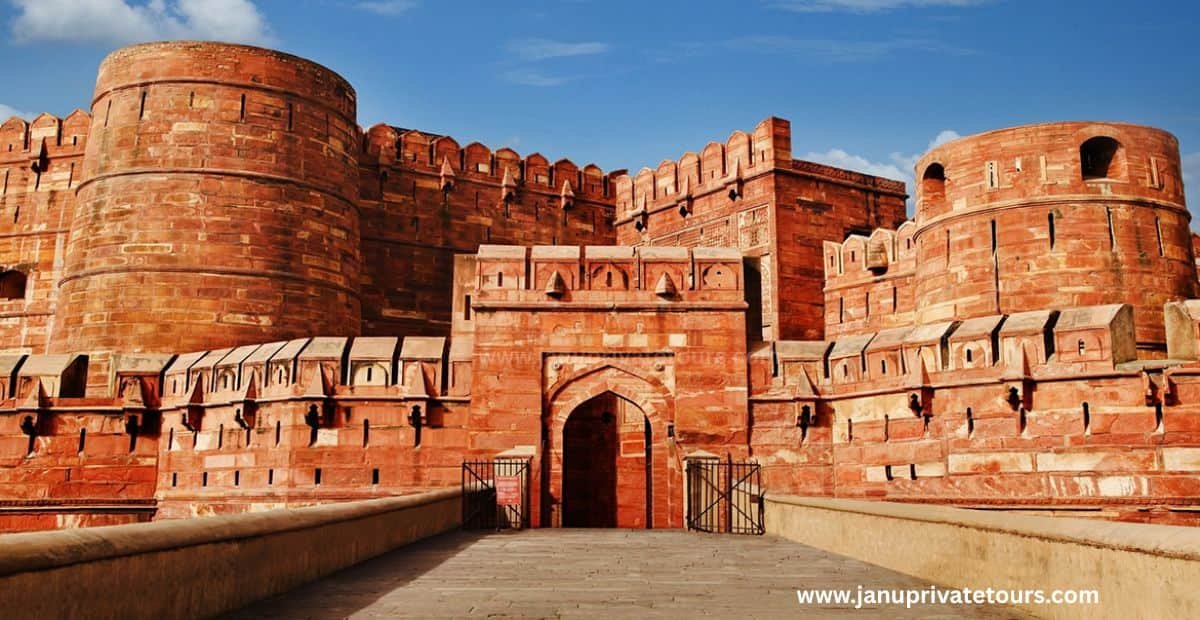
Many tourists who come to Agra visit the Taj Mahal. It is entirely acceptable. However, just two kilometres away is another landmark of the same historic significance and architectural beauty. Agra Fort is one of the most impressive buildings in all of India and is among the least appreciated stops along the Golden Triangle route.
This huge red sandstone fort was the place of Mughal power for many generations. Emperors were crowned here. Wars were fought and lost on the walls. In one of the most moving stories, the emperor who built the Taj Mahal spent his final time in jail, observing his masterpiece through a glass window overlooking the river.
This comprehensive guide will explain the background of Agra Fort, its distinctive architecture, what to look for inside, useful information for visitors, and the best way to include it in your Agra itinerary.
Agra Fort is an UNESCO World Heritage Site located on the banks of the Yamuna River in Agra, Uttar Pradesh. It was declared a World Heritage Site by UNESCO in 1983 for its architectural excellence and historical significance.
The fort is an enormous walled city inside an urban area. The perimeter walls extend over 2.5 kilometers. The walls reach 21 meters in height and are entirely constructed of red sandstone. Within those walls are mosques, palaces, auditoriums, and gardens that represent the full range of Mughal imperial architecture.
Agra Fort served as the main residence of Mughal Emperors during the reigns of Akbar and Aurangzeb, spanning the 16th and 17th centuries. It was more than a fort. It was also the ceremonial, administrative, and domestic apex, the heart of one of the largest empires in the history of mankind.
Understanding Agra Fort’s history requires understanding the growth and change in the Mughal Empire as a whole. The story of the fort spans five centuries and includes several of the most thrilling events within Indian history.
The location in Agra Fort has been occupied longer than most people realize. Historical documents mention Agra Fort dating back to 1080 CE during the Ghaznavid dynasty. At that time it was known as Badalgarh and served as a fortified stronghold.
In 1526, the first Mughal Emperor Babur defeated the Sultan of Delhi in the First Battle of Panipat. Then he captured the Agra fort and briefly used it as a base to establish his home base. It was his grandson, Akbar, who would later completely transform it.
The Agra Fort, which still stands today, was largely built by Emperor Akbar starting in 1565. Akbar considered the Fort’s mud-brick construction inadequate and demanded that it be rebuilt completely using the unique red sandstone quarried in Rajasthan.
The construction took 8 years to complete and involved more than four thousand construction workers working every day. Akbar built a fortress of remarkable size and defense force. The double moat, the high walls, and the two main gateways are from the time of his reign. The architectural style of that period blends Hindu and Islamic practices, typical of Akbar’s inclusive administrative style.
Emperor Jahangir also added his own buildings in Agra Fort, but it was Shah Jahan who made the most significant modifications. Shah Jahan replaced many of Akbar’s red sandstone constructions within the fort using his preferred material, white marble set with semi-precious stone.
It is the result of a fort that has two distinct personalities. The walls that surround it and the earlier sections are made of deep red sandstone. The palaces in the inner areas, built during the time of Shah Jahan, gleam in white marble, adorned with pietra dura inlays depicting floral designs and geometric patterns that match those of the Taj Mahal.
The most emotional and tense section of Agra Fort’s history is Shah Jahan himself. In 1658, his son, Aurangzeb, overthrew him in a coup and confined him to the fort. Shah Jahan spent his final eight years imprisoned in his cell at the Musamman Burj, a white marble structure with direct views across to the Yamuna River toward the Taj Mahal.
According to accounts from the past, Shah Jahan spent much of those years staring at the tomb he had constructed for his wife. When he passed away in 1666, he was buried beside her in the Taj Mahal. The Musamman Burj and the views it offers are among the most uplifting experiences at Agra Fort today.
After the demise of the Mughal Empire, Agra Fort passed through Persian, Maratha, and eventually British hands. The British used a large portion of it as a garrison following 1803. It remained a military facility for years after Indian Independence in 1947. A portion of the fort remains under the control of the Indian Army, which is the reason only certain areas are accessible to visitors.
The Agra Fort’s design is a living document of how Mughal architecture evolved over four Emperors. It is among the few buildings in India where you can observe the transition from Akbar’s red sandstone style, influenced by Hinduism, to the sophisticated, jewel-like white marble style of Shah Jahan in the same place.
Several aspects define the architectural style of Agra Fort.
There’s a lot to see and do in Agra Fort. Here are the most significant structures and things to do in Agra Fort that no visitor must miss:
The most popular entrance for people currently, Amar Singh Gate, is named after a Rajput Chieftain killed in the vicinity. It takes you through a carefully curved path designed to slow the advance of advancing cavalry. The chicane-like approach, as well as the gradual unveiling of the fort’s interior upon entering, is a masterwork of defence design.
Jahangir’s Palace is one of the biggest private residences in Agra Fort and one of the most impressive examples of Akbar-era construction. The building was built primarily in red sandstone and decorated with Hindu designs. Akbar probably constructed it to honour his son Jahangir, the heir to his estate. The intricate carvings on its facade, along with the vast central court, make it one of the fort’s main architectural landmarks.
The structure was constructed in the late 18th century by Shah Jahan. Khas Mahal is a palace built by Shah Jahan. It’s made of white marble and copper-colored roofs, in the Bengali curving style. It served as the Emperor’s private residence. Its contrast with the white marble walls, adorned with gold and turquoise detail, and the red courtyard, which forms the backdrop, is stunning.
This white marble octagonal tower is possibly the most emotionally powerful structure in Agra Fort. It was built for Shah Jahan and served as his gold-plated prison in his final years. If you stand in front of its windows, you’ll be able to witness exactly what he observed as The Taj Mahal rises above the trees along the Yamuna River. On a clear day, the view is spectacular.
The Sheesh Mahal is a magnificent royal bathhouse constructed in the late 19th century by Shah Jahan. The ceilings and walls are covered in thousands of convex mirrors. If candlelight reflected off these mirrors, the effect was believed to be like the sky filled with stars. Even in daylight, the mirrors reflect light and scatter it, creating a stunning display.
The Hall of Public Audiences is an immense, collonaded hall in which the Mughal Emperor received requests for public justice and also administered it. It was constructed in the late 18th century by Shah Jahan. It features an elegantly decorated marble throne in the rear of the hall, where the emperor could sit over the crowd. The room’s size gives an impression of the pomp and grandeur of the Mughal court.
The Hall of Private Audiences is more intimate and intricately decorated than the Diwan-i-Aam. It was the place where the Emperor could meet foreign ambassadors and conduct private affairs of state. The intricate marble screenwork and inlay panels are among the most beautiful instances of Shah Jahan’s architectural style.
A modest, yet exquisite mosque made entirely out of white marble to serve the use of only the ladies in the court of the royals. The proportions are impeccable, and the stonework is flawless. It is among the more tranquil areas within Agra Fort and is worth seeking out.
The most unforgettable thing you can do in Agra Fort is to stroll up the northern ramparts and look over towards the Yamuna River towards the Taj Mahal. From this point, you can see the Taj in all its glory in the distance, framed by the river and the landscape. It’s a different view from the one you see in the Taj Mahal complex itself, and one that many visitors agree is just as moving.
Allow yourself 2 to 3 hours to explore Agra Fort thoroughly. A quick tour of the main structures takes about 90 minutes. If you’ve got a map and wish to learn the history of each structure thoroughly, 3 hours would be more suitable. The fort is massive and has plenty of terrain to explore.
We at Janu Private Tours help you create fully custom Agra and Golden Triangle itineraries that make the most of every minute you’re given. From private morning shuttles to the Taj Mahal and expert guides for a tour of Agra Fort, to seamless transport to Jaipur, we handle everything so you can concentrate on your experience.
Local guides bring Agra Fort’s history to life in a way that only pamphlets and books can. Call Janu Private Tours today and begin planning your perfect Agra tour.
Absolutely. Agra Fort is an entirely different experience from its counterpart, the Taj Mahal. While the Taj is a serene monument, Agra Fort is an all-royal city that includes mosques, palaces, auditoriums, and gardens spanning several periods. Agra Fort also offers the most stunning views of the Taj Mahal from afar, a sight many travellers claim is among their most memorable in India. Don’t miss it.
You should plan for two to three hours at Agra Fort. Self-guided walks through the main structures will take around 90 minutes. A guide will explain the Agra Fort’s history and the architecture in depth, 2.5 to 3 hours is a good time. The fort is huge and offers plenty to see for first-time visitors.
The best time to go is between 8 AM and 11 AM. The light is ideal for photography, the heat hasn’t peaked yet, and crowds are less than at the end of the afternoon. Many tourists pair a sunrise visit to the Taj Mahal with an early morning visit to Agra Fort on the same day, which makes a great combination.
Yes, from the northerly ramparts at Agra Fort, and especially in the Musamman Burj tower, you can see the Taj Mahal across the Yamuna River. This is exactly the same location that the jailed Shah Jahan looked out upon in the final days of his time. It is among the most controversial views in India and shouldn’t be ignored.
The Agra Fort, as it is today, was built primarily through the efforts of Mughal Emperor Akbar, who began construction in 1565 with red sandstone. The fort was significantly altered and expanded by his successors. Emperor Jahangir built several structures, and Emperor Shah Jahan replaced many of Akbar’s sandstone-colored interiors with white palaces during the early 17th century. The area has been filled with fortifications since the 11th century.
Hi, I am Janu (Shabbir Khan)
Book a Free Call
+91 99291 52946