

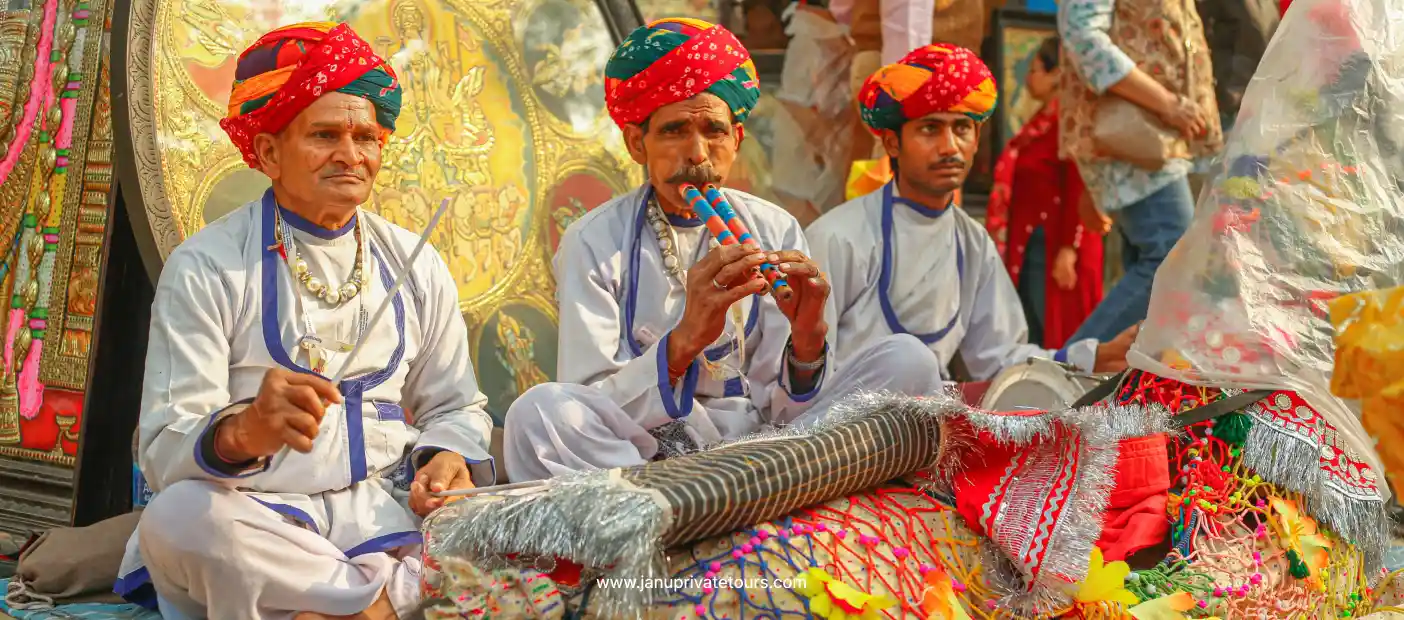
There’s a moment at Jaipur’s Gangaur procession — somewhere along Tripolia Bazaar — when the music stops making sense as separate instruments and becomes a single, physical thing you feel in your sternum. The elephant in front of you is draped in embroidered gold. The women behind it carry a gilded palanquin with the idol of Goddess Gauri, dressed in a crimson silk sari and jasmine garlands, swaying slightly with each step. The women lining the route throw rose petals from their balconies.
A client from Sydney messaged us three months after her Gangaur trip: I’ve done Diwali. I’ve done Holi. Gangaur is the one nobody talks about and the one I’ll remember for the rest of my life.
She’s not wrong. Gangaur is Rajasthan’s longest-running, most elaborate festival — 16 days of daily rituals building toward a single grand procession — and it draws far fewer international visitors than it deserves. Here’s everything you need to plan a trip around it.
Gangaur 2026 ran from March 4 to March 21, with the main procession day on March 21. For 2027, the festival will fall in late March to early April — exact dates follow the Hindu lunar calendar, so check the Rajasthan Tourism website closer to the time.
Gangaur is a love story, a harvest celebration, and a spring festival all folded into one — and understanding the mythology makes watching it unforgettable.
The name itself tells you everything. Gangaur combines two divine names: Gan (a name for Lord Shiva) and Gaur (Goddess Gauri, another name for Parvati). The festival honours the divine union of Shiva and Parvati — specifically the moment after their marriage when Gauri returned to her parental home for 18 days and blessed the women she met with happiness, marital bliss, and prosperity. Women reenact this visit every year by worshipping clay idols of Isar (Shiva) and Gauri for 18 consecutive days before the grand finale.
According to mythology, Goddess Parvati performed intense penance across multiple lifetimes to earn Lord Shiva’s love. Impressed by her devotion, Shiva finally accepted her as his wife. The festival celebrates that devotion — and by extension, every woman’s capacity for patience, persistence, and love.
For married women in Rajasthan, Gangaur is the most important festival of the year. They fast for their husbands’ longevity and family well-being. For unmarried girls, it’s a chance to pray for a good match. But for everyone in the street — including foreign visitors — it’s 16 days of music, colour, and a royal procession that has no equivalent anywhere else in India.
The Gangaur festival also coincides with spring’s arrival, making it a harvest celebration too. After the dry Rajasthani winter, the Chaitra month brings the first warmth and greenery — and Gangaur celebrates that renewal with flowers and fresh offerings to the goddess every morning.
Gangaur falls in spring — and it’s the most pleasant time of year to be in Rajasthan. The festival begins the day after Holi (India’s colour festival, usually late February or early March) and runs for 16 days through the Hindu month of Chaitra (March–April).
Temperatures in Jaipur and Udaipur during Gangaur week typically sit between 22–32°C (72–90°F). Mornings are cool and comfortable; afternoons warm up. The sky is clear, the daylight is long, and the desert landscape starts showing green for the first time since the previous monsoon. Roses and marigolds are in full bloom — which is why the flower garlands, petal offerings, and floral decorations during Gangaur look so extraordinary. The flowers are at their peak and cost next to nothing at this time of year.
For international visitors, this timing is excellent. It’s past the busy November–February peak season, which means hotel rates are slightly lower and the major monuments (City Palace, Amber Fort) are more comfortable to explore. The Golden Triangle circuit is at its best in March — not too cold, not too hot, with excellent light for photography.
Gangaur is primarily a Rajasthan festival, but the celebration takes a different character in each city.
The festival is widely celebrated in Jaipur, Udaipur, Jodhpur, Jaisalmer, Bikaner, and Nathdwara within Rajasthan. Rajasthani communities in Kolkata (West Bengal) and Gujarat also celebrate Gangaur, keeping alive the traditions of their home state. But the most spectacular public celebrations — the ones worth building a trip around — are in Jaipur and Udaipur, for very different reasons.
Jaipur hosts the grandest, most publicly visible procession in India for this festival. The scale is royal in the literal sense — the celebrations are rooted in the patronage of Jaipur’s Rajput royal family, who organised Gangaur processions for centuries. The pageantry here is unmatched.
Udaipur is entirely different. The idols of Isar and Gauri are carried in boats across Lake Pichola, beginning from the City Palace Ghat and moving across the lake as the sun sets. Locals and tourists gather at Gangaur Ghat — a ghat named specifically for this festival — where the lakefront fills with lamps, flower garlands, and devotional music. The Rajasthan Tourism Department also organises the Mewar Festival in Udaipur concurrently, adding cultural performances and heritage events to the lake celebrations.
Jodhpur has the most unusual version. Here, Gangaur is called Dhinga Gavar — and it comes with a tradition unique to this city. Women patrol the streets holding sticks, and local belief holds that if any unmarried young man gets touched by the stick, he will be married soon. The festival here is called Baintmaar Teej in some traditions, and the playful, street-level energy is nothing like Jaipur’s royal formality.
Bikaner’s celebration is best viewed from the ramparts of Junagarh Fort, where the procession below takes on a cinematic quality against the desert city’s terracotta buildings.
The Jaipur Gangaur procession is one of the most photographed events in Rajasthan — and the photographs still don’t prepare you for being there.
The procession begins at Zanani-Deodhi inside the City Palace and moves through Tripolia Bazaar, Chhoti Chaupar, Gangauri Bazaar, and Chaugan Stadium before reaching its final destination at Talkatora — a distance that takes several hours to cover. The route through Jaipur’s old city, flanked by the pink-stuccoed facades of the walled city’s buildings, creates a backdrop that no amount of stage design could replicate.
What you’ll actually see: women in embroidered lehenga-choli sets in crimson, green, and gold carry the Gangaur Mata idol in an ornate palanquin. Decorated elephants, caparisoned camels, royal chariots, and bullock carts accompany the procession. Musicians playing shehnai, dhol, and nagara set a rhythm that carries for several blocks in every direction. Folk dancers perform ghoomar — a swirling Rajasthani dance form — while moving. The entire procession can take 2–3 hours to pass a single vantage point.
The best viewing positions along Tripolia Bazaar fill up an hour before the procession begins. If you want the front row rather than the 12th row, positioning matters — and this is exactly the kind of logistical detail a local guide handles for you, while you focus on watching.
Both are women’s festivals in Rajasthan dedicated to the love of Shiva and Parvati. The confusion between them is completely understandable — but they’re different in season, mood, and scale.
Teej (primarily Haryali Teej) is a monsoon festival, celebrated in July–August when Rajasthan is green and rain-soaked. The dominant mood is of seasonal joy and renewal — swings hung from trees, folk songs in the rain, mehndi on hands, and a procession that celebrates the arrival of the rains. The Jaipur Teej procession is grand and royal, but the festival window is short — the main celebrations happen over 2–3 days.
Gangaur, by contrast, is a spring festival built over 16 continuous days of daily home rituals before the final procession. Where Teej is seasonal joy, Gangaur is devotional endurance — women worship clay idols every morning for more than two weeks before the grand culmination. The emotional weight of the final procession day is enormous because it follows 16 days of preparation.
Scale: Gangaur is generally considered the longer and more elaborate of the two for Rajasthan specifically. In terms of public spectacle, Jaipur’s Gangaur procession rivals Teej in grandeur.
Season: Teej = monsoon (July–August). Gangaur = spring (March–April). Both are worth experiencing; they’re different enough that visitors who’ve done one have strong reasons to return for the other.
Why Teej is celebrated: Teej marks the reunion of Goddess Parvati and Lord Shiva after a long separation, celebrated at the arrival of the monsoon. Married women fast without water (nirjala vrat) for their husbands’ longevity. Unmarried women pray for a good match. The mythology is essentially the same as Gangaur — but the seasonal context transforms the mood entirely.
Gangaur has its own food vocabulary, and ghevar is the word you need to know first.
Ghevar is the undisputed sweet of Gangaur — a honeycomb-textured disc of fried dough soaked in sugar syrup and topped with rabdi (thickened sweetened milk) or malai. You’ll find sweet shops in Jaipur stacking ghevar in the weeks before Gangaur — the Bapu Bazaar and Johari Bazaar mithai shops are the places to go. A good ghevar costs ₹80–350 depending on size (roughly USD 1–4). Get the rabdi version. The dry version is fine; the rabdi version is the reason for the trip.
Ghewar is also the gift of Gangaur — parents of married women send it as part of their blessing packages along with new clothes, mehndi, and bangles. Receiving a ghewar means someone is celebrating you. If a local family offers you one during the festival, eat it immediately. Declining is the one way to genuinely dampen the moment.
Panchkuta sabzi — a dry curry made from five desert ingredients: ker (a tart berry), sangri (dried beans), dried mango, seeds, and spices — is the traditional Gangaur lunch. It’s intensely flavoured, unlike anything you’ve eaten, and completely vegetarian. Malpua (sweet pancakes in sugar syrup, garnished with pistachios) and kheer (slow-cooked rice pudding with saffron and cardamom) round out the festival food table.
During the procession, street vendors along the route sell bhutte ki kees (spiced grated corn stir-fried with ghee), kachori (fried pastry with spiced filling), and chikki (sesame-jaggery brittle). Budget ₹50–150 (under USD 2) for a full street food circuit along Tripolia Bazaar.
Gangaur is welcoming to international visitors — and a few small preparations dramatically improve the experience.
Wearing traditional Rajasthani attire is not required, but it’s appreciated and genuinely transforms how locals interact with you. Women in a bright lehenga-choli or salwar kameez (available in Jaipur’s Bapu Bazaar for USD 15–40, tailored overnight) will be warmly woven into the celebration by women along the procession route. Avoid white and black — the festival palette is red, green, yellow, and gold.
March in Jaipur means warm afternoons — 30–33°C (86–91°F) by 2 PM. The procession starts in the late afternoon and continues into the evening, so you’ll transition from warm sun to comfortable cool. Carry a hat, sunscreen, and a lightweight cotton shawl (useful for both sun coverage and entering any temple along the route).
Photography etiquette: ask before photographing women at close range during rituals. Most women are happy to be photographed in their Gangaur attire — especially if you show them the result on your camera screen. A smile and a gesture asking permission takes three seconds and means everything.
Gangaur is one of those festivals that works best when someone who knows Rajasthan has already solved the logistics. Here’s why that matters practically:
The procession route through Jaipur’s old city has several dozen vantage points of wildly different quality. Being at Tripolia Bazaar near the City Palace gates at the right moment — when the procession is still compact and the light is correct — versus being stuck behind a crowd at Chaugan Stadium an hour later is the difference between a defining photograph and a disappointing one. A local guide who has done this 10 times knows exactly where to be and when.
Gangaur pairs naturally with the Golden Triangle. Delhi → Agra (Taj Mahal) → Jaipur for the main Gangaur procession → Udaipur for the lake boat procession is a 10–12 day private itinerary that covers three of India’s most iconic sights and two completely different Gangaur experiences in a single trip.
For clients who want to combine Jaipur’s procession on the main day with Udaipur’s lake ceremony the following day, the drive between the two cities is 393 km — roughly 5 hours 20 minutes by private car. We schedule this as a morning departure after the Jaipur celebrations, arriving in Udaipur in time for the evening events.
Gangaur 2027 will fall in late March or early April — the exact dates follow the Hindu lunar calendar and are confirmed closer to the year. If you’re planning a spring India trip, late March is the window to hold.
Tell us your travel dates, group size, and whether you prefer Jaipur’s royal procession, Udaipur’s lake ceremony, or both. We’ll design the full Gangaur experience — correct vantage points, local family access, the Gangaur Ghat experience in Udaipur, and the right Rajasthan circuit around it.
Hi, I am Janu (Shabbir Khan)
Book a Free Call
+91 99291 52946