

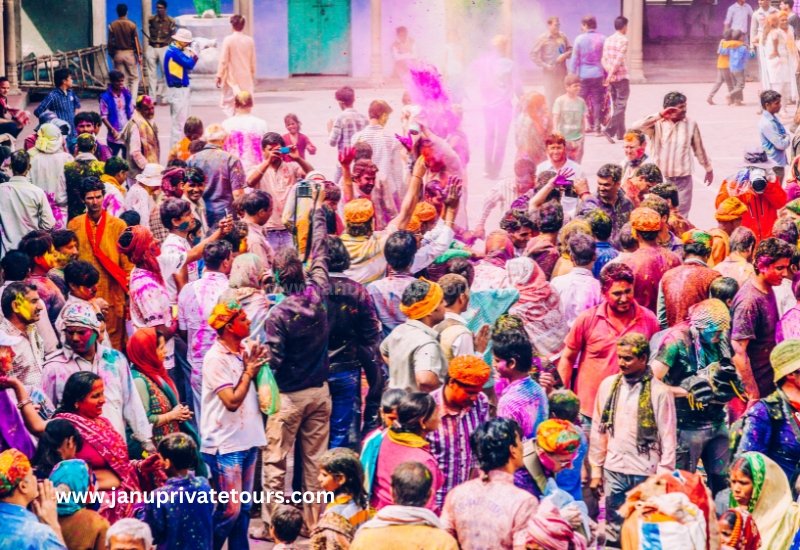
You must have seen those images of people completely drenched in colour, from head to toes. Loud music, streets jam-packed with dancing, jumping and laughing people. Friends running after each other with water guns. Most people always remember the Holi celebration in India.
What you don’t see in those images is the rest of the Holi Celebration in India, which is so much bigger, older, and more intricate than a single image.
In different corners of the country, Holi takes on different versions depending on where you visit. You will witness flowers instead of colour powders, playing with sticks instead of colours. Even turmeric, mud, music and martial arts take the centre stage. These acts come from regional history, mythologies and cultural values of the local communities and are centuries old.
For the foreign traveller, that is the richness of the incredible Holi Celebration in India. You are not simply viewing the same festival played out in a dozen different places in a similar way. You are walking into many different interpretations of a common theme of joy, rejuvenation and coming together.
In this post, we will be covering the various types of Holi celebration in India and their significance.
Before we get into the types of celebrations you could enjoy, let us have a look at the legend of Holi a little more in detail so that you could understand the diversity and, most importantly, respect the festival more.
There is one legend that has to do with Prahlad and Holika, and the triumph of good over evil through the act of Holika Dahan bonfire.
A different, but more popular Holi legend highlights the playful love between Radha and Krishna, in which the throwing of colours is an expression of that love. In some other parts of the country, Holi is connected to Kama and Rati, celebrating desire and union. Some trace its celebration back to local folklore, or even tribal traditions and rituals.
Sikh communities, too, have their own version of Holi through a festival called Hola Mohalla. These legends exist together, sometimes intersecting, sometimes contradicting each other. This diversity is the very beauty of the Holi celebration in India.
Below are the most important types of Holi festivals to know what happens, and also the reasons behind them.
Holi Lathmar is one of the most intense and misunderstood Holi celebrations.
Held in Barsana and Nandgaon, which are villages linked to the stories of Radha and Krishna, it has a central activity where women beat men with sticks. Legend has it that once, Krishna paid a visit to Barsana and began teasing Radha and her friends. Hence, this prompted the women to chase him away with sticks, also known as lathis.
Traditionally, the women will symbolically hit men with sticks, and the men will try to protect themselves. The sticks only lightly touch, but the act is aggressive, performed by community members only.
Lathmar Holi is a popular Holi festival for many tourists, but you should know that the rules of engagement are strict, and outsiders cannot freely join in. Lathmar Holi is not a festival of violence, but a performance of custom.
Phoolon Ki Holi is a type of Holi Festival Celebration in India where colour play is replaced mainly by flower petals. Priests shower flower petals on devotees at temples like Banke Bihari in Vrindavan while bhajans fill the air.
Crowds are dense, but the atmosphere is more serene and less aggressive. There is no pushing, no water balloons, and no wild colour play. For many pilgrims, this is the purest way to celebrate Holi.
Phoolon Ki Holi is a type of Holi celebration in India that reflects surrender, joy through prayer, and spiritual intimacy rather than outward excitement.
Before Lathmar Holi, Barsana hosts Laddu Holi.
Temple balconies shower sweets like laddus on devotees instead of color. The sweets symbolize abundance, blessing, and celebration before the more intense rituals of the festival begin.
Devotees gather laddus as prasad and offer prayers. The atmosphere is fun and joyful, but not chaotic. It is the starting point for the Braj Holi calendar.
This type of Holi Celebration in India highlights the fact that the festival often takes place over a number of days rather than one.
Royal Holi is less about the playfulness of the festival and more about history.
Royal Holi is the legacy of the past. Historically, the erstwhile ruling families would conduct more formal celebrations with ritual processions, folk performances, and public blessings.
A version of this still exists today. Parts of the tradition are kept alive by royal families and in palace courtyards and heritage spaces.
The Holi celebration in Jaipur and Udaipur are the most famous examples of Royal Holi. In Jaipur, events are more organized, traditional, and ceremonial. In Udaipur, Holika Dahan is still performed by the former royal family members.
This type of Holi Celebration in India is less about active participation, more about watching and experiencing the festival. It is more suitable for travelers looking for cultural elegance.
Basanta Utsav is Holi as an art form. Started by Rabindranath Tagore, Basanta Utsav is a fusion of Holi with poetry, music, and classical dance. Students of Visva-Bharati University wear yellow clothes to welcome spring. There is no shouting, chasing, or playing with water in this Holi type. Basanta Utsav, as a Holi celebration in India, is all about expression, art, and rhythm.
Yaosang is a Holi festival that lasts for up to six days. This type of Holi is observed mainly in Manipur and other states in North East India. The festival integrates Holi with local customs and traditions. Color is a part of the celebration, but folk dances, sports, and community rituals receive equal attention. Thabal Chongba, a traditional group dance, is performed and is a major highlight.
In a few parts of Kerala, Holi is called Manjal Kuli. Turmeric mixed with water is used as the colour. It symbolizes purification, healing, and prosperity. The festival is quieter and more ritualistic, practiced mainly by Konkani and Gaud Saraswat Brahmin communities. Manjal Kuli is a South Indian form of Holi Celebration in India that shows how the festival traveled outside the northern Indian origins and adapted to the local belief systems.
Goa’s spring festival is called Shigmo, and this is its version of Holi. Colour play exists, but Shigmo places more emphasis on folklore through parades, street performances, and mythological storytelling. Local communities narrate stories of gods and heroes through group dances. Shigmo, as a Holi celebration in India, emphasises performance, heritage, and community pride.
Rang Panchami takes place a few days after the main Holi festival. Colour play, water fights, and community gatherings are the main focus of this Holi type. In some areas, Dahi Handi is included, where human pyramids are formed to break a pot. Rang Panchami is a type of Holi Celebration in India that represents the playfulness of the festival, without intense religious rituals.
Dolo Jatra is a festival that is observed in Odisha, Assam, and parts of Bengal. Radha and Krishna idols are mounted on decorated swings. Devotees apply color powder on the idols and offer prayers. The festival is devotional and relatively slow-paced with music and chanting. Dolo Jatra is a type of Holi Celebration in India that is a must for travellers who want to explore temple culture and spirituality.
Hola Mohalla does not involve colours at all. It is a showcase of martial arts, mock battles, and physical skills. Sikh warriors put on a display of discipline, courage, and readiness. Guru Gobind Singh started it, and it occurs on the day after Holi. Hola Mohalla, as a Holi festival in India, shows you that this festival has multiple interpretations.
Bhagoria Haat is the Holi festival of tribal communities in Madhya Pradesh and Maharashtra. It celebrates the harvest season and features markets, music, dance, and socializing. Color play is a part of the festival, but ritual, identity, and tradition are more important.
Holi is celebrated with varying traditions in different parts of India. Rituals, mythology, and culture that have been imbibed over centuries in these regions turn Holi into a series of much more profound events than just playing with color. Ranging from devotional and artistic Holi celebrations to those that include displays of arms and even tribal Holi, this festival of India represents diversity in its essence.
If you wish to experience the festival closely with the perfect blend of accessibility, comfort, and insight, you must plan and book your Holi Tour Packages through Janu Private Tours. With tours planned keeping all your needs in mind, you can witness these celebrations respectfully, safely, and comfortably while never missing the moments you matter the most.
India’s regions follow different historical, religious, and cultural traditions. Over centuries, local beliefs blended with Holi, creating unique rituals such as Lathmar Holi, Phoolon Ki Holi, and Shigmo. This diversity reflects how festivals adapt to local identity.
Yes, it is generally safe when approached with awareness and respect. It is best to observe first, follow local guidance, avoid isolated areas, and join organised gatherings or guided experiences, especially in crowded places like Barsana or Vrindavan.
For first-time travellers, Phoolon Ki Holi in Vrindavan, Royal Holi in Jaipur, or Basanta Utsav in Shantiniketan are ideal. These offer structured environments, cultural depth, and less physical intensity compared to street celebrations.
No. Some types of Holi use flowers, turmeric, music, dance, or martial displays instead of colour. Celebrations like Hola Mohalla, Basanta Utsav, and Manjal Kuli focus more on ritual, performance, or community traditions.
Wear modest, comfortable clothing that you do not mind getting stained. Respect personal space, avoid aggressive behaviour, and be mindful near temples and religious areas. Observing local customs and asking before participating helps ensure a positive experience.
Hi, I am Janu (Shabbir Khan)
Book a Free Call
+91 99291 52946