

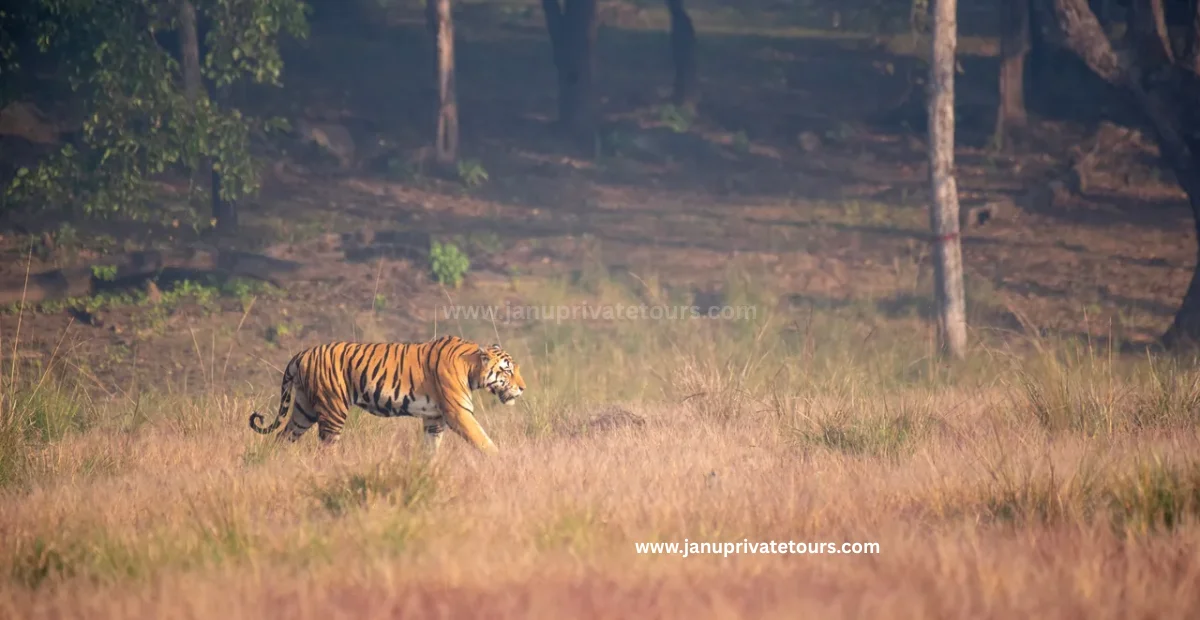
There’s a moment, somewhere between 6:17 AM and the first crack of golden light over the Sal trees, when Kanha stops being a destination and starts being an experience. The damp soil, the alarm calls of langurs overhead and the quiet tension in your guide’s eyes — that’s what you’re actually paying for.
This guide covers everything you need to plan your Kanha safari right: the best seasons, safari timings zone-by-zone, current prices for Indian and foreign visitors and the recommendations our Janu Private Tours naturalists give every guest before they board their jeep.
The short answer: October to March for overall experience; April to June if spotting tigers is your only goal.
The park is open from October 15 to June 30 every year. That’s 8.5 months — and each stretch feels like a completely different park.
Here’s the honest breakdown:
| Season | Months | Temperature | Tiger Visibility | Crowd Level |
| Winter | Oct – Feb | 8°C – 25°C | Good | Moderate to High |
| Peak Sightseeing | Mar – May | 28°C – 42°C | Excellent | Very High |
| Monsoon | Jul – Sep | 20°C – 30°C | Core closed | Very Low |
Our naturalists at Janu Private Tours tend to recommend February as the sweet spot — the light is soft, migratory birds are still around, water sources are beginning to thin (which draws animals out) and the peak-season crowds haven’t fully landed yet. February is rarely talked about. That’s exactly why it works.
Yes — but with one caveat. If you want to photograph tigers, winter is not the best season.
Between November and February, the dense canopy makes sightings harder. Tigers are there; you just can’t always see them. What winter does offer is far more comfortable safari conditions. Temperatures hover between 8°C and 20°C in the mornings and the park is vivid with activity — leopards, wild dogs (dholes), spotted deerand over 300 species of birds.
A guest who traveled with us in December 2024 put it well: “I didn’t see a tiger on day one, but I saw a pack of dholes take down a spotted deer 40 metres from our jeep. I’d forgotten tigers existed.”
Winter is also when the famous Barasingha — the hard-ground swamp deer found almost nowhere else on earth — gathers in herds on Kanha’s meadows. You won’t see anything like it in March.
April and May.
As temperatures climb past 38°C, the forest dries out and tigers — like any sensible creature — move to water sources. With reduced foliage, open grasslands and predictable water points, these months offer the highest probability of tiger sightings in the entire year.
The trade-off is real: it’s hot. Not pleasantly warm — genuinely punishing, particularly on the afternoon safari when the air inside the jeep can feel like an oven. You’ll want to carry at least 2 litres of water, wear a full-sleeve shirt (UV protection, not fashion)and book a lodge with a pool for the midday break.
Is it worth it? Most serious wildlife photographers say yes. Our guides at Janu Private Tours have recorded some of their most memorable tiger encounters in the week between April 15 and April 30 — when the heat is high but the crowds have slightly thinned compared to the festive school holiday rush in March.
Only if you genuinely enjoy the unpredictable — which some people absolutely do.
The core zones of Kanha close from July 1 to September 30 every year. Full stop, no exceptions. However, buffer zones like Khatia, Khapa, Sijora and Rukhad remain operational throughout the monsoon. These aren’t consolation prizes — the jungle in July is a different visual world. Deep greens, flowing streams, mist across the meadows at 7 AM.
What you won’t get is tiger sightings with any regularity. What you might get: leopards, sloth bears, a dramatic sky and the park almost entirely to yourself.
One practical note: road conditions inside buffer zones can change within hours after heavy rainfall. Always check with your guide or lodge the evening before. There’s a reason monsoon safaris carry a “subject to weather” disclaimer — it’s not fine print, it’s genuine advice.
Two safaris run daily: one in the morning and one in the afternoon. There is no midday entry. The safaris run from sunrise to sunset, with a mandatory break between 11:00 AM and 3:00 PM when the core zones are rested.
Here are the confirmed seasonal timings:
| Season | Morning Safari | Afternoon Safari |
| Nov 15 – Feb 15 | 6:00 AM – 11:00 AM | 3:30 PM – Sunset |
| Feb 16 – Apr 30 | 5:45 AM – 10:45 AM | 3:30 PM – 6:30 PM |
| May 1 – Jun 30 | 5:30 AM – 10:30 AM | 3:30 PM – 6:30 PM |
Important timing notes:
A night safari operates in the Khatia buffer zone from 7:00 PM to 10:00 PM. Booking is available at the Khatia Ticket Counter on the day. It’s popular with repeat visitors who’ve already done multiple morning safaris and want something different.
An on-foot jungle walk runs daily from 3:00 PM to 6:30 PM in the buffer zone near Khatia and Mukki gates — organized by the Forest Department. Worth it for the sensory experience alone: the sound of the forest at 4 PM, when the birds shift from midday silence to evening call, is something a jeep never gives you.
Eight in total — four core zones and four buffer zones.
Core zones: Kanha, Kisli, Mukki, Sarhi Buffer zones: Khatia, Khapa, Sijora, Phen
The Kanha Zone (accessed via Khatia Gate) is historically the most popular — dense tiger population, classic meadows and proximity to Kanha Museum. The Mukki Zone on the southern end is quieter and our Janu guides often prefer it in November–December when the Kanha side gets crowded.
Sarhi is the least visited of the four core zones. If you’re doing a 3-day trip and can squeeze in a Sarhi safari on day two, the lower footfall genuinely changes the quality of the experience. Fewer jeeps means less noiseand less noise means more animal activity.
Current pricing (2025–26 season) — subject to government revisions.
The Madhya Pradesh Forest Department periodically updates fees. These are verified rates based on current park information:
| Type | Approximate Cost |
| Full jeep permit (up to 6 people) | ₹6,000 – ₹8,500 (includes permit + guide + jeep hire) |
| Single seat (shared jeep) | ₹1,500 – ₹2,500 per person |
| Permit fee alone | ~₹1,550 per jeep |
| Guide fee | ~₹600 per safari |
| Jeep hire | ~₹2,500 per safari |
Safari entry permit charges are the same for Indian and foreign tourists. This is one of the more traveler-friendly policies at Kanha — unlike some other reserves, there’s no differential “foreigner pricing” at the permit level.
| Type | Cost |
| Per person (Indian or Foreigner) | ₹1,200 per person |
Canter safaris are the option when jeep permits are sold out. Tickets are not available online — only at the gate counter on the day, on a first-come basis. Get there at least 45 minutes before opening. Cash only; cards are not accepted.
| Type | Approximate Cost |
| Night Safari (Khatia buffer zone) | ₹5,000 – ₹7,000 per jeep |
| Full-day Photography Safari | ₹10,000 – ₹11,200 (special permission required 30 days in advance) |
Note: All prices are approximate and subject to change. Always verify current rates on the official MP Forest Department portal (forest.mponline.gov.in) before booking.
Booking sounds straightforward. The reality is slightly more stressful if you’re doing it solo for the first time.
Online booking is available 120 days in advance through the MP Forest Department’s official portal. This is genuinely competitive — popular zones during October and November fill within hours of opening. If you’re planning for December or January, book the moment the 120-day window opens.
What you’ll need:
Lead time guidance:
Once a permit is issued, it is non-transferable and non-refundable. The ID used during booking must be the same ID carried on the day of safari. This is verified at the gate.
If you’re traveling with Janu Private Tours, we handle all permit booking on your behalf, including follow-up on tatkal slots if an earlier window closes out. It removes the single most frustrating part of the process.
Kanha sits in a part of Madhya Pradesh that most tourists dramatically underestimate for distance. Plan your journey before you plan your safari.
By Air: The nearest airport is Jabalpur (JLR), approximately 160 km from Khatia Gate — roughly 3.5 hours by road without major traffic. Nagpur Airport (NAG) is about 285 km away (5–5.5 hours), but has better flight connectivity from major cities. Some guests fly into Raipur (RAI), about 260 km southeast.
By Rail: Jabalpur Junction is well-connected from Mumbai, Delhi, Kolkataand Varanasi. From Jabalpur station, Khatia Gate is about 160 km — budget 3 hours in a private cab. The Gondia railway station (closer to Mukki Gate) is an alternative if you’re approaching from Maharashtra.
By Road: From Jabalpur, take NH30 toward Mandla and then follow state highway routes toward Kanha. The roads improve significantly once you enter the forest buffer zone, but the last 40–50 km can be slow on market days in nearby villages. Our Janu Private Tours drivers typically add 30 minutes to this estimate during local market days (Tuesday and Friday in most villages along this route).
Our naturalists have collectively logged over 2,000 safaris across Kanha’s zones. These are the tips that don’t usually make it into generic travel guides.
Kanha is one of those places that doesn’t really need marketing. Ask anyone who’s been. But planning it well — getting the season right, the zone right, the timings right — is what separates a good safari from one of the better mornings of your life.
If you’d like to plan a private Kanha safari with a Janu Private Tours naturalist, our expert team is here to help. We handle permits, transfers, accommodationand guide allocation so you can focus on the forest.
Hi, I am Janu (Shabbir Khan)
Book a Free Call
+91 99291 52946