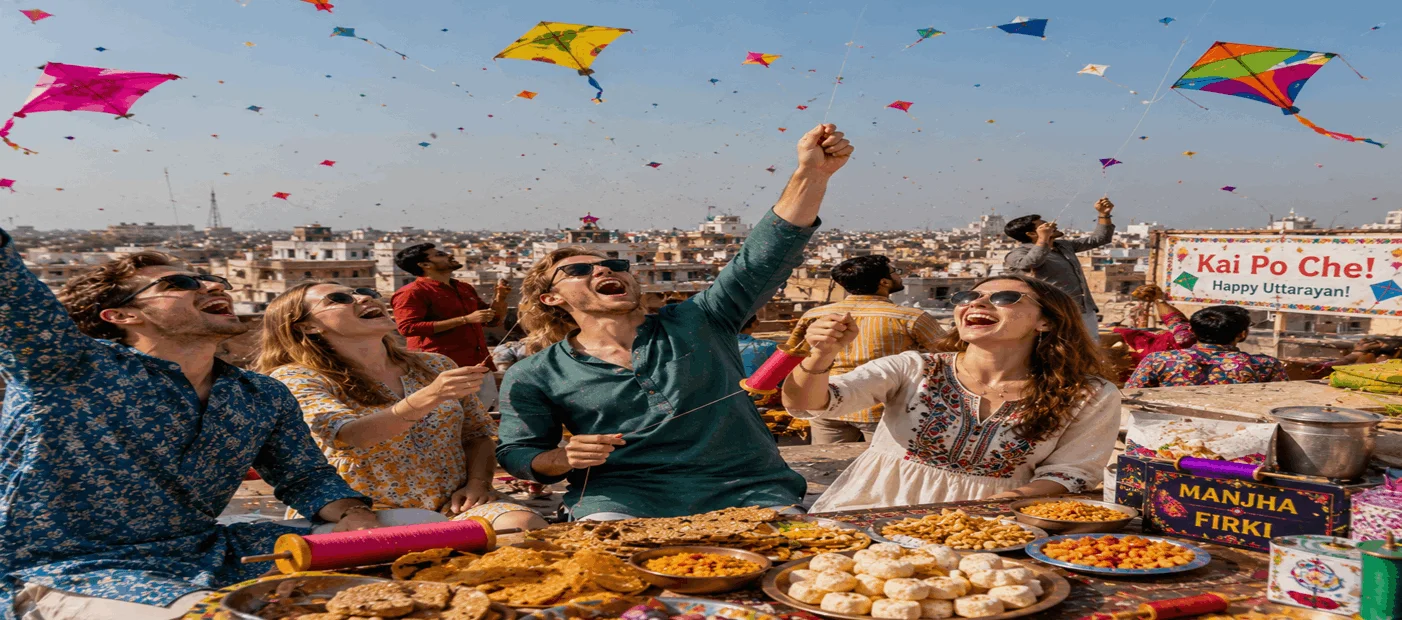
There's a moment on January 14 in Ahmedabad around 8 AM, just after the pre-dawn wind picks up, when you look up and realise the sky has completely disappeared. Not clouds. Kites. Thousands of them, in every colour you can name and several you can't, criss-crossing each other as sharp strings try to cut rivals down. A million voices across the city scream "Kai Po Che!" the Gujarati cry of victory when your string slices through someone else's, and somewhere nearby, a family on a rooftop is sharing a bowl of undhiyu and laughing.
I've been to a lot of festivals. This one is categorically different.
India's kite festival, known as Uttarayan or Makar Sankranti, runs every January, and the 2026 edition drew 135 international kite flyers from 50 countries to Ahmedabad alone. If you haven't planned to come yet, here's everything you need to know before the 2027 edition arrives.
How Is the Kite Festival Celebrated in India?
The kite festival isn't a ticketed event; you attend it as a city-wide phenomenon you get absorbed into. And understanding how it works makes your experience dramatically better.
Celebrations begin in the days before January 14, building like a slow drumroll. The kite markets — particularly the legendary Raipur Darwaza Patang Bazaar in Ahmedabad — open 24 hours a day during the week leading up to the festival. The lanes are stacked floor-to-ceiling with paper-and-bamboo kites of every size, and the bartering and bulk-buying that happens there is a spectacle on its own, even before a single kite takes flight.
On the morning of January 14, children set alarms for 5 AM. Parents who usually struggle to get them out of bed for school find them fully dressed and on the rooftop before sunrise, taking advantage of the ideal pre-dawn wind. By 7 AM, the sky is filling. By 10 AM, it's total. The Sabarmati Riverfront, with a bank capacity of over 500,000 people, becomes a global canvas where kites from Malaysia, Japan, Italy, Indonesia, and the USA share airspace with the traditional Gujarati patangs.
The kites used for fighting are made of lightweight paper stretched over springy bamboo frames, attached to manja, a special string coated with a paste of glue and ground glass, dried to a razor edge. The objective: manoeuvre your kite so your manja cuts through your rival's string. Their kite falls; you've won. Someone screams, "Kai Po Che!" The game immediately restarts. This continues, on rooftops across the entire state of Gujarat, from 5 AM until well past midnight.
At the official International Kite Festival venue at the Sabarmati Riverfront, the format is slightly different, more showcase than combat. Master kite flyers from around the world demonstrate creations that bear no resemblance to anything you've seen before: giant Chinese flying dragons, Italian sculptural kites, Japanese Rokkaku fighting kites, and Malaysian Wau-Balang kites the size of a car. One of Ahmedabad's legendary local flyers, Rasulbhai Rahimbhai, is known for flying trains of hundreds of individual kites on a single string, a sight that stops the crowd every time. Entry to the official festival venue at Sabarmati Riverfront is free for all visitors.
Which States in India Celebrate the Kite Festival?
Gujarat is the undisputed capital of kite flying in India, but the celebration extends far beyond one state.
The festival, known as Makar Sankranti across most of North India, falls on January 14 (sometimes January 15) each year, marking the sun's transition into the Capricorn zodiac, the beginning of the auspicious six-month period of Uttarayana. Every state celebrates this astronomical shift, but the way they do it differs enormously.
Gujarat treats Uttarayan as an official 2-day public holiday. The entire state of Ahmedabad, Surat, Rajkot, Vadodara, Nadiad, and even Dholavira in the remote Kutch desert shuts down normal life and moves to the rooftops. The International Kite Festival (IKF), organised by the Tourism Corporation of Gujarat Limited since 1989, is held across multiple cities in a rolling schedule through January 10–14.
Rajasthan, particularly Jaipur, Jodhpur, and Udaipur, holds enthusiastic kite-flying celebrations on Makar Sankranti. The kite-dotted sky above the Jaipur City Palace and Jodhpur's Mehrangarh Fort on January 14 creates visuals that travel photographers specifically plan trips around. The atmosphere here is more neighbourhood-level than Gujarat's state-wide shutdown, warm, accessible, and easy for foreign visitors to join in.
Telangana (Hyderabad) celebrates kite flying as part of its Sankranti traditions, with competitions held across the city's open grounds.
Delhi and Rajasthan's border regions fly kites enthusiastically across rooftops on January 14, though without the organised festival structure of Gujarat or the heritage backdrop of Rajasthan's fort cities.
West Bengal and South India celebrate Makar Sankranti in different forms as Poush Parbon in Bengal (with sesame sweets and rice dishes) and as Pongal in Tamil Nadu (a 4-day harvest festival), with kite flying a secondary tradition rather than the centrepiece.
How Many Kite Festivals Are There in India?
There isn't one kite festival in India; there are several distinct events worth knowing about, each with a different character.
The International Kite Festival (IKF) in Gujarat is the flagship event, running since 1989. It's organised by the Tourism Corporation of Gujarat and travels across multiple Gujarat cities between January 10 and 14 each year. Ahmedabad hosts the main event at the Sabarmati Riverfront from January 12–14. The 2026 edition saw 135 international participants from 50 countries. This is the one international travelers specifically plan around.
Uttarayan (January 14 and 15) is the broader festival that the IKF is built within the city-wide, rooftop-level mass celebration where 8 to 10 million people across Gujarat participate. The IKF is the international showcase; Uttarayan is the soul of it.
The Jaipur Kite Festival takes place on Makar Sankranti (January 14) across Jaipur's old city rooftops, heritage havelis, and near the City Palace area. It's less internationally organised than Gujarat's event, which is precisely what makes it appealing for visitors who prefer a more intimate, neighbourhood-level experience.
Jodhpur's Makar Sankranti kite flying is similarly rooftop-based and set against the dramatic blue city and Mehrangarh Fort backdrop, one of the most photographed kite festival settings in India.
The kite festival at the Statue of Unity (Ekta Nagar) in Gujarat, launched as part of the expanding Uttarayan circuit, adds a striking modern venue to the programme. The world's tallest statue rising behind kite-covered skies creates one of the more surreal festival photographs you'll take anywhere.
What Does the Sky Look Like During the Kite Festival? (The Part No Photo Prepares You For)
Every photograph you've seen of Uttarayan is technically accurate and somehow completely inadequate. The scale isn't conveyed. The noise isn't conveyed. The smell of food drifting up from rooftops below isn't conveyed.
By 10 AM on January 14, the sky over Ahmedabad is so densely packed with kites that the blue is genuinely difficult to find between them. The dominant sounds are the snapping of kite paper in the wind, the buzz of manja under tension, and the roar of "Kai Po Che!" erupting from different rooftops every 30–40 seconds as another kite is cut loose and spirals down.
The cut kites fall into lanes and streets below, and children sprint through the city in a tradition called latai pado, chasing fallen kites before someone else gets them. It is, objectively, slightly dangerous and completely joyful.
When the sun goes down, the festival doesn't. Kite flyers send up bright white kites visible in the darkness, and skilled locals launch tukkals, paper lanterns strung in long lines from the kite string down to the rooftop, creating a floating galaxy of light across the city's skyline. Ahmedabad's Night Kite Flying event on January 13 is a dedicated celebration of this tradition, and it is extraordinary.
What Do You Eat During the Kite Festival?
You cannot experience Uttarayan without eating through it. The food is inseparable from the festival, and knowing what to look for means you don't miss the best part.
Fafda-Jalebi is the definitive Uttarayan morning combination and one of those food pairings that make zero logical sense until you try it. Fafda is a crunchy, salty gram flour snack. Jalebi is a deep-fried spiral soaked in saffron sugar syrup. Salt and sweet together, eaten on a rooftop at 7 AM with the first kites in the sky, it's one of the best breakfast experiences India offers.
Undhiyu is the centrepiece dish of Uttarayan, a slow-cooked winter vegetable casserole made with seasonal greens, papdi beans, yams, and muthiya (spiced fenugreek dumplings), traditionally cooked upside down in earthen pots. It's rich, warming, and the reason Gujarati families spend the entire day on the rooftop: the undhiyu is up there with them.
Chikki brittle made from jaggery with sesame seeds (til), peanuts, or puffed rice is the on-the-go snack. You'll find vendors walking through the festival crowds with trays of it. Budget roughly ₹20–50 (under USD 1) per piece.
At the Sabarmati Riverfront, food stalls from across Gujarat line the festival grounds, offering everything from street snacks to full thali spreads. Bring cash; most stalls don't take cards.
Practical Tips for International Visitors at the Kite Festival
A few things you genuinely need to know before you go:
Protect Your Hands and Neck
The manja (glass-coated kite string) that falls from cut kites is sharp enough to cut skin, and it drifts down from the sky invisibly. Many regular visitors wear thin gloves on their string hand and a light scarf around the neck on the main festival days. This isn't paranoia; it's sensible. The festival organisers increasingly use synthetic manja with rounded edges at official venues, but traditional glass manja is still widely used in the city.
Wear Comfortable, Sun-Ready Clothing
January in Gujarat means clear skies and temperatures between 15–28°C (59–82°F), pleasant in the morning, genuinely warm by early afternoon. You'll be outdoors for 8–10 hours. Sunscreen, a hat, and a light layer for the early morning are the practical kit.
Book Accommodation in Ahmedabad Very Early
For the 2026 festival, most decent hotels near the Sabarmati Riverfront were fully booked by October 2025. For 2027, book 4–5 months ahead. Prices during Uttarayan week run 50–100% above standard rates.
The official IKF venue entry is free. You do not need a ticket to enter the Sabarmati Riverfront for the International Kite Festival. For rooftop access with a local family — a vastly better experience than the official venue, this is something a local guide or private tour operator (like us) can arrange.
How to Plan Your Kite Festival Tour to India with Janu Private Tours
The kite festival is one of those experiences that works best when someone who knows India builds the logistics around you. Here's why that matters:
Ahmedabad alone doesn't need a full trip. The festival pairs beautifully with Rajasthan, a private circuit from Jaipur (where you catch Makar Sankranti kite flying on the 14th), then to Jodhpur for the blue city at its most photogenic, then into Gujarat for the International Kite Festival in Ahmedabad. A 10–12 day itinerary covers all of it without rushing.
For clients who've already done the Golden Triangle tour, a Rajasthan-plus-Kite-Festival combination is a compelling reason to return to India in January, a different season, a different energy, a completely different experience.
We arrange rooftop access with local Ahmedabad families on the main Uttarayan day, the genuinely local version, not the tourist-facing official event. We organise visits to Patang Bazaar before the festival, kite-flying lessons if you want them, and the right position at the Sabarmati Riverfront for the night lantern display on January 13.
The 2027 edition will be on January 14. If you're travelling from the US, UK, Australia, or Canada and want to build a January India festival trip, the time to plan is now, not three weeks before departure.
Tell us your travel dates, group size, and whether you'd like the full Rajasthan-plus-Gujarat circuit or a focused Gujarat experience. We'll handle everything else.
Also Read: