

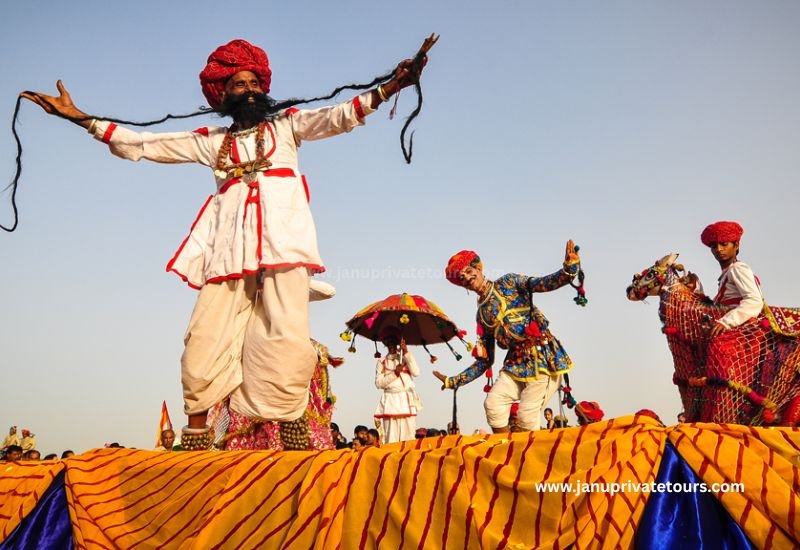
Rajasthan is fondly known as a “Land of Forts and Palaces,” but its real treasure is in its living culture. Each village, town, and desert settlement has a culture that has been shaped by the influences of history, religion, and everyday life that have been imprinted over the centuries. Music drifts through courtyards, colors paint the town during festivals, and ancient traditions are still practiced with quiet pride.
To know Rajasthan is to know its people, its festivals, and the stories that are told through its dances, its art, and its traditions. The Rajasthan Cultural Guide delves into the essence of the region through its folk dances, festivals, and traditions, providing a glimpse into a culture that is very much alive and not stuck in the past, but is, in fact, lived every day.
Folk dances in Rajasthan are not just performed to receive applause. They are a part of life celebrations such as harvests, weddings, victories, and religious congregations. Every region in Rajasthan has its own unique style of folk dances. Let us understand this aspect of the Rajasthan cultural guide.
Ghoomar is one of the most identifiable dance styles in Rajasthan. It is a slow dance performed by women, characterized by circular movements and ghagras. The dance style originated in the Bhil tribe and was later adopted by the royal families of Rajputs.
Women perform this dance in groups during festivals and weddings. The dance is characterized by slow and controlled movements, exuding elegance and poise. Ghoomar is often accompanied by traditional songs that talk about love, seasons, and life.
Kalbelia is a dance style performed by the Kalbelia tribe, who were snake charmers. This dance style is fast-paced, energetic, and very expressive. The dance style imitates the movements of snakes through flexible body movements and quick footwork.
Kalbelia has been recognized by UNESCO as an Intangible Cultural Heritage. Kalbelia is typically performed during festivals and fairs. The black swirling skirts and beats of the music create a mesmerizing effect that is raw and very powerful.
Bhavai is more than a dance form. It is a display of strength and endurance. Women perform intricate steps while balancing several pots on their heads, sometimes dancing on sharp edges.
This dance form is commonly used to depict stories of social causes, bravery, and social life. Bhavai performances are commonly seen in fairs and cultural events and are a treat to watch, as the performers’ control over their bodies is a source of wonder.
The Chari dance belongs to the Kishangarh region. The dance is performed by women, who carry brass pots with fire on their heads. The dance symbolizes joy and festivities, especially after the rains in the desert.
The light emitted by the flames against the dark background is simply stunning. The dance symbolizes how people in the desert celebrate even the smallest joys of life.
Moving on, the next aspect of the Rajasthan cultural guide is music. Music in Rajasthan is deeply connected to storytelling. The songs are passed down from generation to generation orally. The instruments are not very complicated, but the emotions are very deep.
The Manganiyar and Langa communities are some of the communities that are known for their musical heritage. Their songs are all about love, devotion, kings, wars, and everyday life. The use of sarangi, kamayacha, and dholak creates layered sounds that have a very earthy feel to them.
Music is all around in temples, courtyards, weddings, and even in the fields while working.
Festivals in Rajasthan are grand, colorful, and rich in significance. They are a blend of religion, socializing, and artistic expression. Let us take a closer look at the festivals in this Rajasthan cultural guide.
The Desert Festival is a celebration of life in the Thar Desert. Held in Jaisalmer, it includes events such as camel races, folk performances, turban tying competitions, and traditional dress. This festival highlights the ability of desert communities to turn adverse situations into occasions for celebration. The desert is brought alive by the sounds of music, dance, and celebration.
The Pushkar Camel Fair is one of the largest livestock fairs in the world. It takes place in Pushkar and is a combination of trade and religious festivals, as well as cultural shows.
Pilgrims take a dip in holy water, while traders trade camels, and performers entertain the crowds. The Pushkar Camel Fair is an embodiment of the combination of trade, religion, and celebration in Rajasthan.
The Teej Festival is a celebration of the relationship between Goddess Parvati and Lord Shiva. The festival is also observed as the onset of monsoons and is one of the most significant festivals for women. Women observe the festival by wearing green dresses, singing folk songs, and participating in merrymaking activities like swinging on colored jhoolas. Processions with idols are taken out in cities like Jaipur, and the roads are filled with the spirit of festivities.
The Gangaur Festival is a celebration of the Goddess Gauri and the happiness of married life. Unmarried women observe the festival by praying for good husbands, while married women pray for the longevity of their husbands. The festival takes place through colorful processions, decorative statues and group prayers. Jaipur and Udaipur celebrate the Gangaur Festival with elaborate festivities.
Rajasthan clothing serves a purpose beyond showing current fashion trends. The clothing style of the people of Rajasthan is determined by factors like weather conditions, social group, geography, and their occupation. Men typically dress in dhotis or pyjamas with angarkhas and colorful turbans. The turban’s design and color serve to reveal both the wearer’s caste background and their geographical roots. Women wear ghagras, cholis, and odhnis, which feature mirror work, embroidery and block prints. Several villages still use traditional clothing as their everyday attire.
Rajasthani cuisine originates from the dry climate of Rajasthan, as water was scarce. People developed cooking techniques which needed less water because they wanted to conserve food and use less water. Some common dishes include dal baati churma, gatte ki sabzi, ker sangri and more. The food here is rich, filling, aromatic, and at times spicy. Rajasthani people use food to demonstrate their hospitality towards others. People show their warmth towards guests through meal sharing because it is a symbol of respect and friendship.
The social life of Rajasthan is woven around community living. The villages function on a joint sense of responsibility and social traditions. The elderly have important roles, and rituals define life’s milestones from birth to death. Wedding ceremonies are very elaborate and symbolic. Music, dance, and rituals can go on for several days. Celebrations bring the whole community together, and social barriers are overcome by the power of celebrations. These traditions are still an integral part of people’s lives despite the influence of modernization.
The art forms of Rajasthan include block printing, pottery, miniature paintings, leather work, and jewelry making. There are several crafts that are carried out by families who have been doing the same work for generations. The markets in Rajasthan are filled with these crafts. However, more importantly, the workshops are still operational in homes, keeping the traditions alive. Art is not something that is separated from life in Rajasthan. It is a part of life.
The culture of Rajasthan is layered, rich, and deeply human. The folk dances of Rajasthan speak of survival and joy. The festivals of Rajasthan speak of devotion and happiness. The culture of Rajasthan weaves past and present together effortlessly. To experience Rajasthan completely, travel slowly. Attend local festivals. Watch a folk dance in a village courtyard. Share meals. Listen more than you speak.
If you are interested in exploring Rajasthan in a way that is culturally rich and comfortable, Janu Private Tours offers trips that focus on authentic experiences, local engagement, and responsible travel. We can help you experience Rajasthan. So why wait? Book now.
The best time is from October to March, as most festivals and fairs happen during this time of the year, along with favourable weather.
Folk dances are performed on occasions like festivals, weddings, and other special events. Cultural shows in cities provide regular performances.
Yes. The royal support helped to sustain music, dance, architecture, and crafts, which form the backbone of Rajasthan’s culture.
Yes, most festivals are open to visitors. One can take part in them with respect, especially during community festivals.
One can experience the real culture of Rajasthan by traveling with local guides, attending village events, visiting crafts workshops, and opting for cultural tours such as those offered by Janu Private Tours.
Hi, I am Janu (Shabbir Khan)
Book a Free Call
+91 99291 52946