

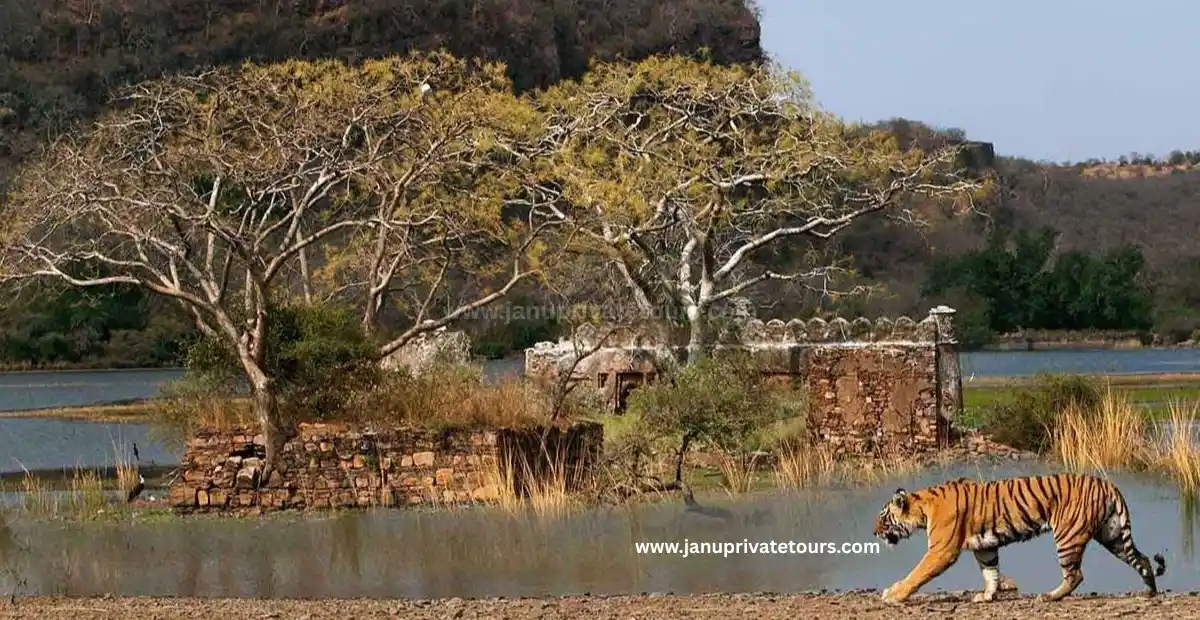
Ranthambore is one of those rare places where you genuinely cannot predict your morning. You could spend three hours watching a sambar deer graze peacefully, or you could round a bend and find a Bengal tiger cooling off at Padam Talao — 15 feet from your jeep. That unpredictability is exactly the point.
This guide covers everything: safari charges, timings, zones, how to reach the park, and practical tips from guides who’ve done this for years. No filler, no fluff.
Ranthambore National Park sits in the Sawai Madhopur district of southeastern Rajasthan, roughly 180 km from Jaipur. It’s tucked between two ancient hill ranges — the Aravalli to the northwest and the Vindhya to the southeast which gives the landscape that dramatic, almost cinematic quality that makes wildlife photography here so addictive.
The park covers a total area of 1,334 sq km, including the Kailadevi Wildlife Sanctuary and Sawai Mansingh Sanctuary. Its core zone spans approximately 275 sq km the original protected forest where tiger sightings were first documented under Project Tiger in 1973.
The gateway town is Sawai Madhopur, just 11–14 km from the park entrance. Most hotels, resorts, and safari operators are clustered here or along the road leading to the park gates.
Ranthambore is India’s most famous tiger-watching destination, but the park’s wildlife extends well beyond its star attraction.
As of 2022, the park was home to 69 confirmed Bengal tigers, with estimates suggesting over 75 roam the reserve today. The safari-accessible zones (Zones 1–5 primarily) host roughly 25 tigers — each with a named territory and, if you follow wildlife circles, a loyal fan following.
Beyond tigers, expect to see:
May and June, despite the heat, are actually the best months for sightings — animals concentrate around the three major lakes (Padam Talao, Raj Bagh Talao, Malik Talao) as water sources shrink elsewhere. Personally, I think the early October re-opening has its own magic — the forest is lush green, still dripping from monsoon rains, and the tigers are well-fed and active.
Ranthambore is divided into 10 distinct safari zones, split between the core area (Zones 1–5) and buffer zones (Zones 6–10). Each zone covers different terrain, wildlife density, and photography opportunities.
Core Zones (1–5): These are the original protected forests with historically higher tiger density. They’re more forested, denser in vegetation, and where most of the named tigers hold territory.
Buffer Zones (6–10):
Added later to extend the park’s conservation coverage. Less crowded, good for leopards, bears, and birding.
One practical thing to know:
Zone 1–5 closes every Tuesday and Zone 6–10 closes every Wednesday for maintenance. Book accordingly. On Tuesdays, all safari vehicles are pushed into zones 6–10, which creates more crowds there and thinner coverage in the core — something most first-timers don’t realize until they arrive.
Two vehicle types operate in Ranthambore:
The Jeep Safari and the Canter Safari. Both are managed by the Rajasthan Forest Department, and private vehicles are strictly not permitted inside the park.
A 6-seater open-top gypsy (actually 4 guests + driver + naturalist guide). Nimble, quieter, and significantly better for photography and wildlife encounters. You can go deeper into zones where canters can’t. This is what Janu Private Tours recommends for serious wildlife enthusiasts or anyone who wants a more immersive experience. Advance booking opens 90 days before your safari date.
A 20-seater open bus. More affordable, social, and a solid option for larger groups or budget travellers. Not permitted in Zones 7 and 8. Canters are louder, which can sometimes spook wildlife before you’re close enough to appreciate the encounter.
A limited option (only 5 jeeps per day) that allows extended time inside the park — either 6 hours (half-day) or 12 hours from sunrise to sunset (full-day). No zone restrictions apply for these permits. You can bring packed lunch or return to your hotel mid-day. Availability is genuinely scarce; book well in advance.
Choice Jeep and Choice Guide options also exist for guests who want a luxury jeep upgrade or a specific certified naturalist. Charges vary.
Safari timings in Ranthambore change seasonally based on sunrise and sunset. The park operates two shifts daily — morning and afternoon. Each shift runs approximately 3 to 3.5 hours.
Arrive at the gate30–45 minutes before your designated departure time — latecomers forfeit their slot without refund.
| Season | Morning Safari | Afternoon safari |
| October – January | 7:00 AM – 10:30 AM | 2:30 PM – 6:00 PM |
| February – March | 6:30 AM – 10:00 AM | 2:30 PM – 6:00 PM |
| April – June | 6:00 AM – 9:30 AM | 3:00 PM – 6:30 PM |
Monsoon season (July – September):
Zones 1–5 are fully closed. Zones 6–10 remain open for safaris during this period, offering a quieter, greener, and genuinely underrated experience.
Morning safaris are widely considered the better slot — cooler temperatures, active predators, and the golden light that makes every photograph look effortless. That said, afternoon safaris have produced some of the most dramatic tiger sightings precisely because the animals are more relaxed near water at dusk.
Safari prices in Ranthambore vary by vehicle type, visitor nationality, and zone. The Forest Department updated pricing in April 2024 (with approximately a 10–30% increase), so double-check current rates on the official Rajasthan Forest portal before booking.
| Visitor Type | Approximate Charge (Government Rate) |
| Indian National | ₹1,000 – ₹2,200 (incl. guide + entry fees) |
| Foreign Tourist | ₹2,231 – ₹4,200 (incl. guide + entry fees) |
Note: Service charges and GST apply over government rates. Tatkal (last-minute) booking carries an additional surcharge.
| Visitor Type | Approximate Charge |
| Indian National | ₹700 – ₹1,200 |
| Foreign Tourist | ₹1,500 – ₹2,500 |
Children under 5:
Free entry. Children aged 5–12 are typically charged adult rates.
Still camera: No additional charge. Video camera: Additional fee applies (varies by season — confirm at the gate).
Booking modes:
Honest note: These are government base rates, and verified numbers shift year to year. Your tour operator’s quoted price will include taxes, operator fees, and possibly a premium jeep or guide upgrade. Always ask for an itemized breakdown.
Ranthambore is more than a tiger reserve — it’s a layered destination where wildlife, medieval history, and Rajasthani culture converge.
Perched on a 700-foot hill 5 km inside the reserve, this fort predates the Mughals and was once considered impregnable by Akbar’s generals. It’s a UNESCO World Heritage Site (listed as one of the Hill Forts of Rajasthan) and offers panoramic views of the forest below. Tigers have been photographed lounging in its ruins — one of the most iconic images in Indian wildlife photography.
Inside the fort complex, this 10th-century Ganesha temple receives devotees from across India. Wedding invitation cards are traditionally mailed here. It’s a deeply local tradition most tourists never know about.
Three interconnected lakes within the park. Padam Talao is the largest and the most reliable spot for tiger and crocodile sightings. Early morning mist over these lakes — with the fort silhouette in the background — is one of those sights you genuinely don’t forget.
Located in Sawai Madhopur town, this small school trains local youth in tiger-themed folk art. Worth 45 minutes of your time and directly supports conservation-linked livelihoods.
Just outside the park’s boundaries. Surwal Lake (about 23 km from Sawai Madhopur — roughly 35 minutes without traffic) is a winter birding hotspot with flamingos and bar-headed geese. The Chambal River stretch nearby offers gharial and river dolphin sightings.
October to April is the sweet spot — good weather, high wildlife activity, and the core zones fully open. Within that window, different months suit different goals.
If I had to pick one month? March. The landscape is transforming, the light is extraordinary, and tiger sightings near the lakes are reliable without the extreme heat of May.
The easiest and most reliable way to reach Ranthambore is by train to Sawai Madhopur Junction, which sits just 11 km from the park entrance and is well-served by express trains from Delhi, Jaipur, Mumbai, and Kota.
The Ranthambore Express (12465/12466) and the Golden Temple Mail (12903/12904) are popular options from Delhi. The train from Delhi to Sawai Madhopur takes approximately 5 hours. From Jaipur, the same journey is just under 2 hours — making a Jaipur-Ranthambore day trip feasible, though overnight stays are far more rewarding.
The nearest commercial airport is Jaipur International Airport (JIA), approximately 160–180 km from the park. The drive from Jaipur takes 3.5 to 4 hours under normal traffic. International visitors typically fly into Delhi (approximately 350–390 km away) and connect by train or road.
Roads to Ranthambore are well-maintained and scenic. State highways pass through traditional Rajasthani villages and open farmland. Taxis and private cars are readily available from Jaipur, Kota, Agra, and Delhi. Government buses also operate on this route, though they’re less convenient for luggage-heavy travellers.
| City | Road Distance | Approx. Drive Time | Best Transport |
| Jaipur | 180Km | 3.5 – 4 hours | Train (2 hrs) or taxi |
| Delhi | 390 Km | 6 – 8 hours | Train (5 hrs) or overnight taxi |
| Agra | 235 Km | 4 – 5 hours | Train (3.5 hrs) via Bharatpur |
| Kota | 110 Km | 2 – 2.5 hours | Road or Train |
| Udaipur | 370 Km | 6 -7 hours | Road or train via Chittorgarh |
| Mumbai | 1030 km | 18+ hours by road | Train (overnight, ~14 hrs) |
Distances are approximate. Road times exclude traffic delays — add 30–45 minutes for holiday weekends and festival seasons.
Accommodation options in and around Sawai Madhopur range from forest department guesthouses to heritage luxury tents. The general rule: stay as close to the park gate as possible to make the most of early morning departure windows.
Government-run forest rest houses are available for booking through the official portal — basic, clean, and unbeatable for atmosphere. Several guesthouses along Ranthambore Road offer clean rooms in the ₹1,500–₹5,000 range per night.
Several premium properties have established themselves as benchmarks for Ranthambore stays:
Janu Private Tours recommends
booking accommodation and safari slots simultaneously, as peak season (December–February) fills both within days of availability opening. A 3-night stay allows at least 4 safaris across different zones — the minimum for a meaningful tiger-watching experience.
Here’s what most guides won’t tell you — the small things that separate a frustrating trip from a memorable one.
On safaris:
On photography:
On booking:
On uncertainty:
Even the most experienced guides at Ranthambore will tell you — tiger sightings are never guaranteed. The park is not a zoo. But what Ranthambore guarantees is this: every single safari, something remarkable happens. Even a monsoon-season zone 8 safari through empty-seeming forest has its own quality of attention, its own silence. That’s worth something, independent of the tiger count.
Planning a private Ranthambore safari? Janu Private Tours specializes in curated wildlife experiences across Rajasthan, combining Ranthambore with Jaipur, Agra, or the Ranthambore–Udaipur–Jodhpur circuit. Contact our travel specialists for personalized itinerary recommendations.
Hi, I am Janu (Shabbir Khan)
Book a Free Call
+91 99291 52946