

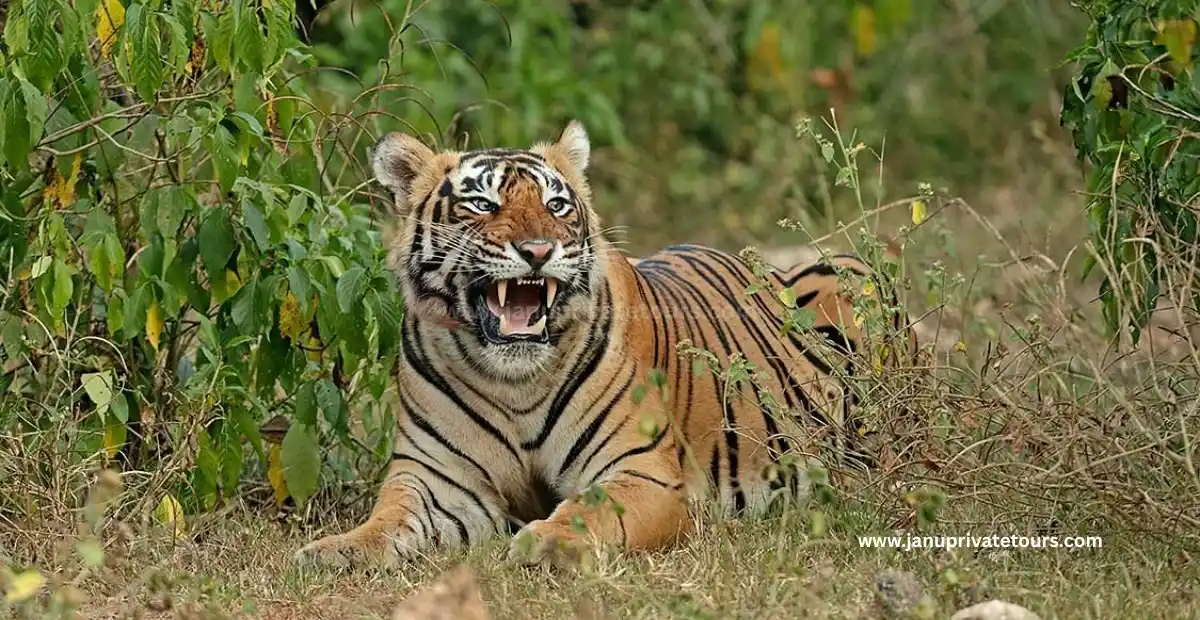
Here’s something most Rajasthan travel guides won’t tell you: Sariska is the world’s first tiger reserve to have successfully relocated tigers after local extinction. That’s not a marketing line — it’s a conservation milestone verified by the National Tiger Conservation Authority (NTCA) and the Wildlife Institute of India. And yet, the reserve still gets a fraction of Ranthambore’s crowds.
If you’re planning a wildlife trip to Rajasthan and wondering whether Sariska Tiger Reserve deserves a spot on your itinerary — yes, it does. Here’s everything you need to know, including what we atJanu Private Tours recommend after years of curating experiences across India’s finest wild spaces.
The easiest way to describe Sariska is to say it’s Ranthambore-lite. That would also be completely wrong.
Sariska spans a core tiger habitat of 881 km² plus a 322.23 km² buffer area, totalling 1,203.34 km² — a landscape of scrub-thorn arid forests, dry deciduous forests, grasslands, and rocky Aravalli hills. That’s a genuinely diverse terrain. One hour you’re tracking pug marks on a dry riverbed; the next, you’re looking up at the ancient Kankwari Fort — a Mughal-era structure sitting right inside the reserve.
Sariska holds the unique distinction of being the first reserve in the world to successfully relocate tigers after local extinction, making it a landmark in global conservation history. According to a March 2023 survey, the tiger population has risen to 32, putting the sighting probability at a realistic 60–70% per safari — not a guarantee, but solid odds.
Beyond tigers, over 25 mammal species are recorded here, including striped hyena, golden jackal, desert fox, jungle cat, rusty-spotted cat, palm civets, hedgehogs, porcupines, and mongoose. And yes, there are crocodiles lazing around the reserve’s lakes too — which most people don’t expect in Rajasthan.
Add to that a 200-year-old palace turned heritage hotel, temples hidden in the jungle, and roads that haven’t yet been overrun by tourist traffic. That’s why Sariska is worth visiting on its own terms.
The short answer: October to March for comfort; March to June for tiger sightings.
Winters from October to March offer optimum weather and high diurnal activity from the big cats. Temperatures hover between 8°C and 25°C, mornings are crisp, and visibility across the Aravalli slopes is excellent. You’ll likely spot sambar deer and nilgai out in the open during these months.
March to June is when things get serious for tiger tracking. Summers push temperatures up to 46°C, which forces the big cats to visit water bodies more frequently — making sightings far more predictable than in winter. The logic is simple: less cover, more heat, more animals near water. Your guide knows where every waterhole is.
The core zone closes from 1 July to 30 September during the monsoon. That said, buffer zone safaris continue, and if you visit in July, you’ll be rewarded with dancing peacocks, fresh green hills, and almost no other tourists. It’s a completely different mood — quieter, softer, and equally valid.
Our Janu Private Tours recommendation: If you want the best of both worlds — good weather and decent sighting odds — plan your visit between mid-October and mid-November or mid-February to March. You’ll avoid peak crowds while catching animals on the move as seasons shift.
Wednesday is the weekly holiday at Sariska — the reserve closes for tourism that day. Don’t make the mistake of booking travel without factoring this in.
Forget pre-packaged wildlife television. A safari here is dustier, more personal, and honestly more real.
Safaris run in two shifts — morning and evening — and each lasts approximately 3.5 hours. You enter from one of four gates: Sariska Gate (Core Zone), Telha Gate (Core Zone), Baraliwari Gate (Buffer Zone), and Bala Quila Gate (Buffer Zone).
Zone 2 (Slopka and Kaalighati route) sees the most frequent tiger activity. Zone 1, the Pandupol route, is better for birdwatching and temple visits — including a centuries-old Hanuman temple tucked into the hills that’s worth visiting regardless of your wildlife luck.
The jeep — a 4×4 Maruti Gypsy — seats up to six passengers. Your driver and naturalist guide travel with you; their costs are included in the standard safari fee. The driver and guide are randomly assigned by the forest department’s automated system to ensure fair distribution across zones, so you can’t request a specific guide through official channels. If you’re booking through Janu Private Tours, we work with trusted naturalists from the park periphery who have decades of local knowledge — that makes a genuine difference.
One guest who traveled with us in February 2024 described the experience this way: “We’d done Ranthambore twice and almost skipped Sariska. I’m so glad we didn’t. We sat in silence for 40 minutes near a waterhole, and then ST-22 walked right past us. No other vehicles. Just us.”
That’s the Sariska difference. Less footfall, more moments.
The star is obviously the Royal Bengal Tiger, but here’s what you might actually see over a 3.5-hour drive.
Mammals: The reserve harbours sloth bear, Indian leopard, jungle cat, caracal, striped hyena, golden jackal, chital, sambar deer, nilgai, wild boar, small Indian civet, Javan mongoose, ruddy mongoose, honey badger, rhesus macaque, and Northern plains gray langur. Between 25 and 30 leopards are estimated to live in the reserve — the rocky Aravalli terrain suits them perfectly.
Birds: 211 bird species have been recorded at Sariska, of which 120 are resident, 73 are migratory, and 18 are considered vagrants. Species present include grey francolin, white-throated kingfisher, Indian peafowl, bush quail, sandgrouse, treepie, golden-backed woodpecker, crested serpent eagle, and the Indian eagle-owl. Sariska reportedly has one of the highest densities of Indian peafowl of any reserve in the country.
Reptiles: Marsh crocodiles around the lakes catch most visitors off guard. Indian pythons, cobras, and monitor lizards round out the reptile list. Worth watching the ground in Zone 1.
The most photographed tiger in recent years has been ST-7, locally known as “Ponytail” — named for a distinctive tuft of fur at the tail tip. If your guide mentions a recent sighting in Zone 2, that’s usually your best bet.
Current pricing for the 2025–26 season (subject to revision by the Rajasthan Forest Department):
| Safari Type | Indian Nationals | Foreign Nationals |
| Gypsy (Jeep) Safari – Per Seat | ₹1,440 | Higher differential applies |
| Canter Safari – Per Seat | ₹1,010 | Higher differential applies |
The Canter (20-seater open minibus) is priced at ₹1,010 per person and the Gypsy (6-seater 4×4) at ₹1,440 per person for the 2026–27 season. These prices include the jungle safari ticket, boarding pass, nature guide, and driver charges — you’re not paying extras on top.
For foreign nationals, the park entry fee stands at ₹470, while Indian nationals pay ₹80. This base entry fee is separate from safari vehicle charges, so international visitors should factor both into their budget.
Children below 5 years enter free of charge.
A full private jeep for 6 people works out significantly cheaper per person than comparable safari experiences at Ranthambore — especially for small groups. If there are 4 of you traveling together, book the full jeep rather than shared seats. The intimacy is worth the modest premium.
Drone photography inside the reserve is prohibited without official authorization. Carrying a DSLR camera is fine — but plan to leave your DJI at the hotel.
Book early, and always pay in full upfront.
Online advance booking is available up to 365 days before your visit date and covers up to 75% of available safari seats. The remaining 25% are released at the gate on the day — but depending on the season, those spots go within minutes of opening.
The booking is done on a first-come, first-served basis. Full payment is required in advance, and confirmed bookings are non-refundable and non-transferable. No exceptions.
From Sariska Gate, 15 jeeps (6 seats each) and 15 canters (20 seats each) are permitted entry per shift. From Telha and Baraliwari gates, 5 jeeps per shift are allowed. That’s a fairly small number — which is exactly what keeps Sariska from being overrun.
You can book directly through the Rajasthan Forest Department’s official website or through authorized agents. If you’re booking through Janu Private Tours, we handle the permits, timing, and all logistics — so you focus on looking out of the jeep, not at a booking portal.
Show up at least 10–15 minutes before your safari departure. Late arrivals are denied entry even with valid, paid bookings — the forest department is strict about this, and rightly so.
Practical advice that actually matters:Getting there:
Sariska sits in Alwar district, Rajasthan. The reserve is 200 km from Delhi, 36 km from Alwar, and approximately 101 km from Jaipur. From Jaipur, you’re looking at a roughly 2.5 to 3-hour drive on NH-48. From Delhi, allow 3.5 to 4 hours depending on traffic after Gurgaon. Alwar Junction is the nearest railway station — from there, a cab to the reserve takes about an hour.
What to wear: Earthy tones. Olive, khaki, beige. Avoid white and bright colours — they’re visible at a distance and disturb animals before you’ve even seen them. A light jacket or shawl for morning safaris between October and February is non-negotiable; the open gypsy at dawn can be genuinely cold.
Photography: The best light is in the first 45 minutes of the morning safari and the last 45 minutes of the evening one. Carry a telephoto lens if you have one — 300mm minimum is ideal for big cats at distance. A monopod is more practical than a tripod in a moving jeep.
Noise and scent: Keep conversation low inside the forest. Avoid strong perfumes — not just for wildlife etiquette, but because certain scents genuinely mask the animal smell that your guide is tracking. The naturalists at Sariska work partly by scent.
Accommodation: Stay inside or adjacent to the reserve, not in Alwar town. Options include RTDC Hotel Tiger Den, the heritage Sariska Palace, and eco-lodge Vanaashrya Resort — all within 10–15 km of the main gates. Booking 4–6 weeks in advance during October–March peak season is strongly advised.
The midday gap: Safaris don’t run midday, which leaves you 3–4 hours between shifts. Use this time to visit Kankwari Fort (inside the reserve — arrange access through your agent), or just rest. The forest at midday, even in summer, deserves stillness.
We’ve helped dozens of guests experience Sariska — not just tick it off a list. Here’s what our guides consistently recommend:
Do two safaris, not one. A single safari gives you a taste. Two gives you a story. The morning and evening shifts show completely different animal behaviour — morning is predator-tracking, evening is when the deer come out in open grasslands and the light turns gold.
Combine Sariska with Alwar. The Alwar City Palace and its museum hold one of Rajasthan’s most underrated royal collections, including Mughal miniature paintings and a Persian manuscript library. It’s 37 km from the reserve — an easy half-day addition.
Ask your guide about ST-22 and ST-27. These two tigers have home ranges that overlap Zone 1 and Zone 2. Your naturalist will know recent sighting patterns. Trust them on route selection.
Skip the canter for your first visit. The jeep gives you closer access, a lower profile, and the freedom to slow down or stop without 19 other people shifting in their seats. It’s simply a better experience — especially for photographers.
The best 48 hours looks like this: Drive from Jaipur in the afternoon, check in to Sariska Palace, evening safari, dinner under the Aravalli sky, morning safari with an early wake-up call, late breakfast, then Kankwari Fort or Pandupol Temple before heading out.
| Detail | Information |
| Location | Alwar district, Rajasthan |
| Total Area | 1,203.34 km² (core + buffer) |
| Status | Tiger Reserve since 1978 (Project Tiger); National Park since 1982 |
| Tiger Population | 32 (as of 2023 survey) |
| Best Months | October–March (comfort); March–June (sightings) |
| Core Zone Closed | 1 July – 30 September |
| Weekly Closure | Wednesday (no tourism) |
| Safari Duration | 3.5 hours per shift |
| Safari Options | Jeep (6-seater) or Canter (20-seater) |
| Distance from Jaipur | 101 km |
| Distance from Delhi | 200 Km |
| Nearest Railway Station | Alwar Junction (36 KM) |
Planning a trip to Sariska? Janu Private Tours designs private, curated wildlife and heritage experiences across Rajasthan — from Sariska to the Thar. Reach us at januprivatetours.com to start building your itinerary.
Sources: National Tiger Conservation Authority (NTCA), Wildlife Institute of India, Wikipedia – Sariska Tiger Reserve, Rajasthan Forest Department, sariskasafari.in (2026 pricing), hawamahaltickets.com (2025 fee update).
Hi, I am Janu (Shabbir Khan)
Book a Free Call
+91 99291 52946