

The evening before Teej in Jaipur, every courtyard in the old city smells the same — a mixture of rose water and henna paste. Women sit in circles having mehndi drawn up to their elbows while someone nearby plays a dhol and someone else sings a Teej folk song that her grandmother taught her. The streets are strung with marigold garlands. The sweet shops are stacking ghevar — Rajasthan’s honeycomb-textured festival sweet — three layers deep.
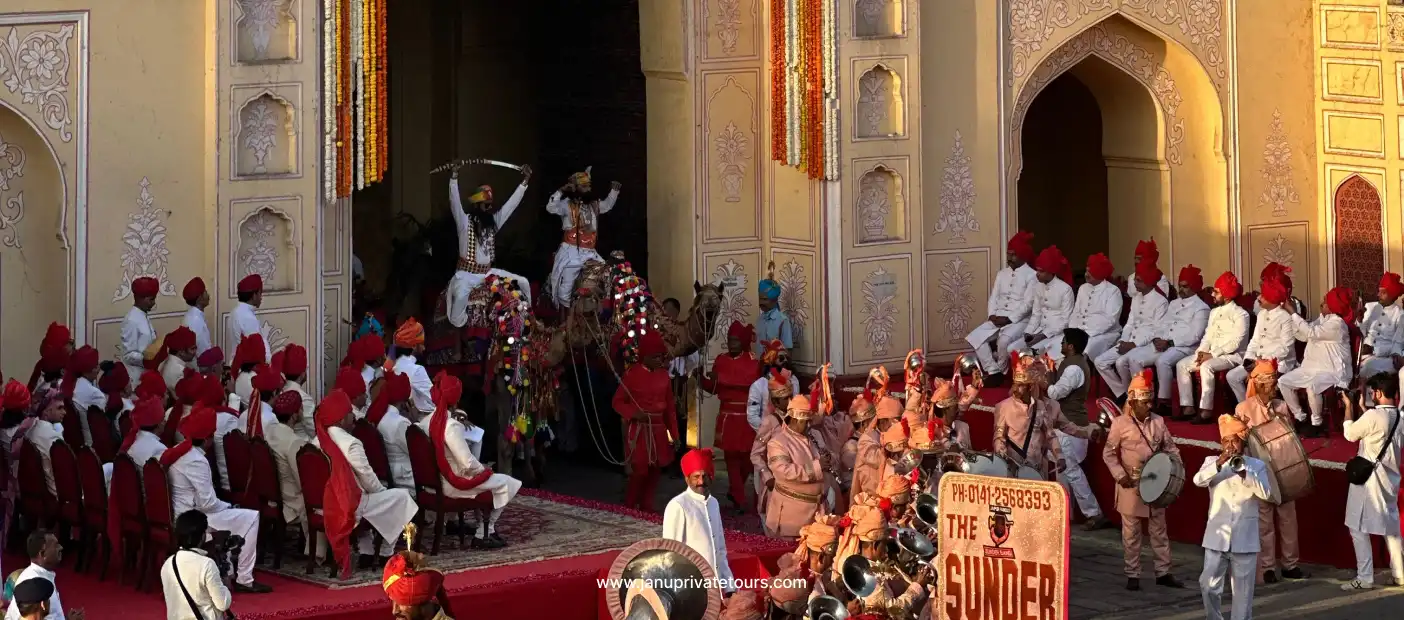
The next morning, a gilded palanquin carrying the idol of Goddess Teej Mata glides out through the gates of Jaipur’s City Palace, escorted by royal guards in red turbans, decorated elephants, and a percussion procession you feel in your chest before you hear it.
Most international visitors have never heard of Teej. The ones who time their Rajasthan trip around it never forget it.
Haryali Teej 2026 falls on Sunday, July 27 — the main public festival in Jaipur, marked by the royal procession from the City Palace. Hartalika Teej follows on August 26, 2026. If India is on your radar for 2026, the monsoon season just became a very good reason to go.
Teej is a love story that spans 108 lifetimes — and India celebrates it every monsoon. The mythology behind it is one of the most extraordinary tales in the Hindu tradition, and understanding it makes watching the festival a completely different experience.
According to the Shiva Purana, Goddess Parvati’s journey to reunite with Lord Shiva was not a single-lifetime effort. After her first incarnation as Sati, she underwent 107 successive rebirths, practising intense penance across each one, until Shiva finally accepted her. The day he gave his word to marry her — after she made a Shiva Lingam from sand and prayed through the night — became Hartalika Teej.
The term Hartalika is a combination of two Sanskrit words: harit (abduction) and aalika (female friend). Legend says Goddess Parvati’s father wanted her to marry Lord Vishnu, but she was devoted to Shiva. Her female friends helped her escape and hide in a forest so she could continue her penance undisturbed — and that act of friendship is honoured in the festival’s name.
The festivals celebrate the bounty of nature, the arrival of clouds and rain, and the renewal that monsoon brings. Beyond mythology, Teej marks the monsoon season in a desert state where rain is genuinely precious. In Rajasthan’s dry landscape, the first green of the Shravan month feels like a miracle — and Teej celebrates that too.
Married women observe Teej by fasting and praying for their husbands’ well-being. Unmarried women fast and pray for a good match. The men, for their part, send gifts. For foreign visitors, the festival is an open-air celebration of colour, music, and devotion that anyone can witness and — with a bit of local guidance — participate in.
Teej is a North and West India phenomenon, with Rajasthan at the centre of the grandest celebrations. But the festival extends across several states, each with its own character.
The main areas of celebration are Rajasthan, Bihar, eastern Uttar Pradesh, Jharkhand, Uttarakhand, and Nepal. Hartalika Teej has also spread to parts of Madhya Pradesh and Chhattisgarh.
Rajasthan, specifically Jaipur, is where the festival reaches its most spectacular, publicly visible form. Unlike other parts of India, Jaipur’s Teej Festival is celebrated on a royal scale, with a spectacular Teej Mata procession where the deity of Goddess Parvati is taken out in a grand palanquin from the City Palace, accompanied by royal guards, chariots, decorated elephants, camels, and traditional musicians. For international visitors, this is the version worth building a trip around.
Bundi (2.5 hours from Jaipur) holds the famous Kajali Teej Mela — a fair specific to the Kajari Teej form of the festival, celebrated in this under-touristed old city with a river procession. Far fewer foreign tourists make it here, which makes the atmosphere more intimate and the access easier.
Uttar Pradesh and Bihar celebrate Teej with similar rituals — fasting, swings, folk songs — but without the royal procession element that defines Rajasthan’s version.
Nepal celebrates Teej as a major national festival, particularly in Kathmandu, where temples fill with women in red sarees for three days of prayer and fasting.
If you’re choosing a single base for Teej in India, Jaipur is the answer. The combination of the royal procession, the old city backdrop, and the sheer scale of public celebration makes it the most immersive Teej experience available to international visitors.
Teej unfolds over several days, each with a specific ritual — and the day before the main festival is one of the most atmospheric for visitors.
The day before Haryali Teej is celebrated as Sinjara, when women apply mehndi on their hands and feet. Parents of married women send a gift pack that includes bindi, vermilion, mehndi, bangles, ghevar (a special Rajasthani sweet), and lahariya (a multicoloured saree) as a symbol of their blessings. Walk through any neighbourhood the evening before Teej in Jaipur, and you’ll find women in every courtyard having intricate henna designs drawn up their forearms, while their children run between the mehndi artists and the mithai shops.
On the main festival day, married women observe the nirjala vrat, a strict fast without water, for the well-being and long life of their husbands. Unmarried girls fast and pray for a good match. This is a deeply personal devotional practice happening alongside the street celebrations — you’ll see women in beautiful green and red embroidered lehengas who have eaten nothing since the previous evening, completing the full procession route before breaking their fast at sunset.
The festivals for women include dancing, singing, getting together with friends and telling stories, dressing up with henna-coloured hands and feet, wearing red, green or orange clothes, sharing festive foods, and playing on swings hung from trees. The swings — jhoolas — decorated with flowers and hung from banyan or mango trees, are one of the most distinctive and photographed elements of Teej. Women take turns on them singing traditional Teej songs. The visual, with embroidered silk and monsoon greenery, is the kind of thing travel photographers plan entire trips around.
Nothing in Rajasthan’s festival calendar looks quite like the Jaipur Teej procession — and that’s saying something. The high point is the magnificently decorated idol of Goddess Parvati, kept on a palanquin carried through the Pink City. Antique gilt palanquins, bullock carts pulling cannons, chariots, caparisoned elephants, camels, bands, and dance groups form part of the grand procession.
The pink-walled streets of Jaipur burst into life with folk dancers, shehnai melodies, ghoomar performers, and an infectious festive spirit. Locals line up along the route to witness this rare event — Teej Mata is brought out only once a year.
The procession starts from Tripolia Gate at the City Palace and moves through the old city. The route through the walled city — past the Hawa Mahal’s latticed pink facade, through the colour-soaked lanes of Johari Bazaar — takes several hours. The best viewing positions fill up early. A local guide who knows the route makes the difference between watching from 10 rows back and standing at the front as the elephant with the gold-draped palanquin passes three metres in front of you.
The procession is carried out over two consecutive days, and the dressed-up idol of Teej Mata finally ends her journey at Kanak Vrindavan — a garden complex at the foot of the Nahargarh hills, about 8 km from the old city. The arrival there, with the hills behind and the idol finally settled, is the emotional climax of the festival.
Teej has its own food calendar, and ghevar is the centrepiece. Ghevar is the undisputed queen of Teej sweets — a honeycomb-textured disc of fried dough soaked in sugar syrup and topped with rabdi (thickened milk) or malai. It’s available throughout monsoon season but reaches its peak during Teej. Pick it up at LMB (Laxmi Misthan Bhandar) in Johari Bazaar, or any of the mithai shops along Bapu Bazaar. A single ghevar at a good shop costs ₹80–300 (roughly USD 1–3.50) depending on size and topping. Go for the rabdi version.
Parents of married women send Sinjara — a gift pack that includes ghevar — as a symbol of their blessings, alongside bangles, mehndi, and a lahariya saree. The sweet is so integral to the festival that receiving a ghevar means someone is celebrating you.
Balushahi is a flaky, deep-fried sweet with a glazed finish — similar to a glazed doughnut in concept but richer in flavour and much denser. Fenia is thin sweet vermicelli cooked in milk with saffron and cardamom, lighter and more delicate than most Rajasthani sweets. It’s the one to try if you have a low tolerance for sugar overload.
Laapsi is a sweet wheat porridge cooked with ghee, jaggery, and nuts — traditionally prepared as a festive offering to Goddess Parvati. You’ll find it at temple stalls on the main festival day, distributed as prasad (sacred food offering) to whoever is standing nearby. Accept it.
Once the fast breaks at sunset, the first food many women eat is savoury — kachori with spiced potato filling from the street stalls that line the old city. If you’ve been walking the procession route all day, you’ll understand why.
Green is the colour of Teej — wearing it earns you instant goodwill from every woman you encounter. This isn’t a festival where foreign visitors are expected to dress traditionally, but making the effort is noticed and genuinely appreciated.
Women visitors in a green or red salwar kameez (tunic and trouser set, available in Jaipur markets from USD 12–30, tailored to your measurement in 24 hours) will be welcomed into the festival atmosphere in a way that western clothing simply doesn’t enable. Green symbolises the monsoon’s new growth — the season the entire festival is built around.
Men in a simple kurta (tunic over trousers or jeans) in any colour fit comfortably into the crowd without drawing attention. Comfortable shoes are essential — the procession route through the old city covers 4–5 km on uneven stone surfaces. The monsoon weather means humidity; lightweight, breathable fabric is far more comfortable than denim.
Carry a small umbrella. Jaipur in late July sits in active monsoon season — temperatures hover around 28–32°C (82–90°F) with periodic rain showers. The rain during Teej is considered auspicious. The locals celebrate it. You should too — but a compact umbrella keeps your camera dry.
Jaipur is the grand, publicly accessible version. These nearby cities offer something more intimate.
Bundi — 165 km from Jaipur (roughly 3 hours by car) — holds the Kajali Teej Mela, a riverside fair specific to this under-visited walled city. The procession here is smaller and genuinely neighbourhood-level, set against Bundi’s painted havelis and step-wells without any tourist infrastructure around it. If you’ve already done Jaipur’s procession on Day 1, Bundi on Kajari Teej (15 days later) is a second, entirely different experience.
Udaipur celebrates Teej with women swinging on flower-decorated jhoolas beside Lake Pichola — the combination of lake, white palace backdrop, and monsoon greenery is visually spectacular. Less public procession than Jaipur, but more romantic and photogenic.
Jodhpur’s Teej celebrations take place against the Blue City’s rooftops and Mehrangarh Fort’s dramatic silhouette. Like Udaipur, it’s more neighbourhood-level than Jaipur’s royal-scale event, but the setting is unmatched.
A Rajasthan circuit that combines Jaipur’s Teej procession with Udaipur or Bundi in a 6–8 day private itinerary covers the full range — from the large-scale royal event to the intimate, local version. This is exactly the kind of trip we design for our international clients.
Teej is genuinely one of Rajasthan’s most extraordinary experiences for international visitors — and one of the most underbooked. Most foreign tourists haven’t heard of it. The ones who come specifically for it tell us it changed how they think about India.
The practical realities: Jaipur hotels in the old city during Teej week book out fast, especially for the night before the procession (Sinjara evening) when the mehndi atmosphere is at its most beautiful. Rooms within walking distance of Tripolia Bazaar and the procession route should be booked 3–4 months ahead.
Teej pairs naturally with the Golden Triangle. Delhi → Agra (Taj Mahal) → Jaipur, arriving for the Teej procession on July 27, then extending into Rajasthan through Udaipur or Jodhpur — it’s a 10–12 day itinerary that combines India’s most iconic sights with one of its least-visited-by-foreigners festivals. We run this as a private circuit, with a local guide who positions you at the right point on the procession route and takes you into the mehndi lanes the evening before.
Haryali Teej 2026 is July 27. If your travel window includes late July, this is worth building around.
Tell us your travel dates, where you’re flying from, and your group size. We’ll design the full Teej experience — procession access, local family visit, Sinjara evening in the old city, and the right Rajasthan circuit before and after.
Hi, I am Janu (Shabbir Khan)
Book a Free Call
+91 99291 52946