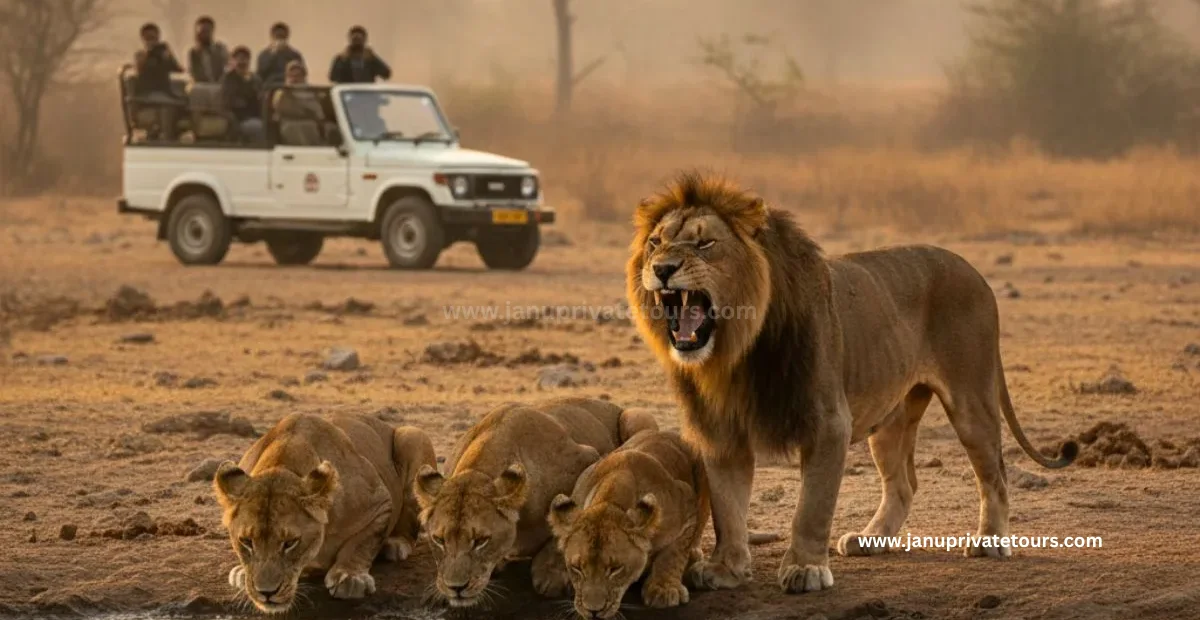
Gir National Park in Gujarat is the only place on Earth where you can watch a wild Asiatic lion in its natural habitat. Not in a zoo. Not in a wildlife documentary. In a real, sun-baked teak forest where the grass crunches under your jeep tyres and your guide whispers "stop" with a grip that means business.
This guide covers everything you need to plan your Gir trip — timings, weather by season, 2026 safari prices for Indians and foreigners, booking tips, and the attractions that make Gir more than just a lion safari. If you are short on time, the answer-first version: visit between November and February, book your e-permit at least 4–6 weeks early, and do the morning slot.
What Are the Safari Timings at Gir National Park?
Gir National Park offers two safari slots daily, scheduled according to seasonal daylight hours. Morning safaris generally operate between 6:30 AM and 9:30 AM, and evening safaris run between 3:00 PM and 6:00 PM.
Each safari lasts approximately three hours and covers one of the designated jeep routes inside the park — which route you get is assigned randomly at the entry gate. You cannot choose it. That random element is part of the experience, honestly.
The early morning slot from 6:30 AM to 9:30 AM is considered the best time to spot lions and other wildlife, as animals are more active during the cool morning hours. You also get better light for photography — that soft, golden Gujarat sunrise makes even a hyena look photogenic.
What About Devaliya Safari Timings?
Devaliya Safari timings are 7 AM, 8 AM, 9 AM, 10 AM, 3 PM, 4 PM, and 5 PM. The park is closed every Wednesday. Each Devaliya slot runs for approximately 55 minutes — shorter than the core jungle safari, but the enclosed zone gives you near-guaranteed lion sightings, which is why first-timers or families with young children often prefer it.
What Is the Best Time to Visit Gir National Park?
The best time to visit Gir National Park for a wildlife safari is from October to March, when the weather is pleasant and animal movement is high, making safaris comfortable and rewarding.
That said, "best time" depends on what you are after. Let me break it down honestly:
Winter (November – February): The Comfortable Choice
The winter season is considered the best time to visit Gir National Park. During this period, the temperature ranges from 10°C to 22°C, creating pleasant weather conditions for wildlife exploration. The cool air, clear skies, and active wildlife make winter the perfect time for safaris.
The months of October, November, and February are the most comfortable as the temperature remains neither too cold nor too hot. Winter is considered the peak tourist season in Gir, and hence an advance booking of safari is highly recommended.
If you are visiting Gir for the first time, this is your window. The mornings feel crisp — carry a light jacket because 10°C at 6:30 AM in an open jeep is more biting than it sounds.
Summer (March – June): Best for Lion Sightings
Summers in Gir can be harsh, with temperatures rising between 29°C and 42°C. Although the afternoons can be scorching, mornings and late evenings are still good for spotting wildlife, as animals often gather around water bodies to escape the heat.
For those who want to see the Asiatic Lions, the months of April and May are considered the best. When the waterholes dry up and temperatures peak, lions have fewer places to hide. That makes early morning safaris in April and May paradoxically excellent for sightings — just be prepared to sweat through your khakis by 9 AM.
The best lion-sighting logic is that heat pushes animals toward waterholes, especially in early mornings. Carry sun protection.
Monsoon (Mid-June – Mid-October): When the Park Closes
Safari booking for the Gir Jungle Trail remains suspended from 16th June till 15th October every year due to weather conditions.
During the monsoon season, Gir National Park receives moderate to heavy rainfall, and the core safari zones remain closed to visitors for conservation and forest regeneration. This closure period is essential for the breeding of wildlife and the natural recovery of the forest ecosystem. However, Devaliya Safari Park remains open during the monsoon season and offers visitors a safe and well-managed wildlife viewing experience.
If you find yourself in Gujarat during the monsoon with a free afternoon and lion fever, Devaliya is your only option — and it delivers.
How Much Does a Gir Safari Cost in 2026?
Here is the part most travel blogs either get wrong or deliberately vague about. Let us be direct.
The prices of Gir lion safari may vary from ₹5,500 to ₹8,000 (inclusive of permit, gypsy, guide charges, and services and taxes). The prices may vary on weekends, number of persons, festivals, and long weekends.
The prices of the Sasan Gir safari for a foreign tourist can be between ₹15,500 to ₹17,500 (inclusive of permit, gypsy, guide charges, and services and taxes).
Here is a quick-reference table for 2026:
| Category | Weekday Price (per Jeep) | Notes |
| Indian Nationals | ₹5,500 – ₹8,000 | Up to 6 adults per jeep |
| Foreign Nationals / NRI | ₹15,500 – ₹17,500 | Passport details mandatory |
| Devaliya (Indians) | ₹4,800 – ₹6,200 | Based on 4/6/8-seater |
| Devaliya (Foreigners) | From ₹12,500 | Per Jeep |
In one e-permit, a maximum of 6 persons (one child aged 3 to 12 years) are allowed. The permit does not include safari vehicle charges, guide charges, or service charges — always confirm the all-inclusive price before booking.
Camera Fees (Often Overlooked)
Camera fees for Indian nationals: ₹200+ per camera per visit for cameras above 7.1 megapixels, paid directly in cash. For foreign nationals: ₹1,400+ per camera per visit for cameras above 7.1 megapixels. Government service tax is extra on top of this. If you are bringing a DSLR or mirrorless camera, budget for this separately — most people forget and get surprised at the gate.
Cancellation Policy
If you cancel your ride before 10 days of your permit date, you can get a 75% refund. Cancel closer than 10 days and you are unlikely to see much back.
How to Book a Gir Safari: Step-by-Step
The process of online jeep safari booking at the Sasan Gir National Park and Wildlife Sanctuary is meticulously supervised by Gir forest officials, strictly adhering to the rules and regulations set forth by India's forest department. 100% of the total safari permits for the Gir Jungle Trail are made accessible through online platforms.
Book only through the official Gir online portal (girnationalparkonline.nic.in) — the Gujarat Forest Department manages it directly.
- Step 1: Create an account on the official permit booking site.
- Step 2: Choose your safari type — Core Jungle Trail, Devaliya Interpretation Zone, or Kankai-Banej Forest Tour.
- Step 3: Select your date and time slot, then fill in all visitor details with valid ID proof.
- Step 4: Complete payment online. Download and carry your e-permit.
Foreign nationals are required to provide their foreign tourist passport details. Tourists can request safari booking up to three months prior to their actual arrival. Six persons can visit the Gir Jungle Trail with one e-permit.
Janu Private Tours Tip: During peak season (December–February), popular morning slots sell out within hours of opening. Our guides recommend booking 4–6 weeks ahead, and for December or the week around Diwali, closer to 8–10 weeks. We handle all bookings for our guests, including route strategy across multiple safari days to maximise your chances of seeing lions, leopards, and the elusive sloth bear.
Always book your safari permit in advance. Arriving at least 30 minutes before your safari timing ensures a smooth entry process and better chances of getting a good guide and driver.
What Animals Will You See at Gir National Park?
The main attraction of Gir is the Asiatic Lion (Panthera leo persica), which has now populated to around 411 in number. With approximately 295 species of birds, 39 species of mammals, and 37 species of reptiles, Gir boasts a fantastic array of fauna.
Key predators besides Asiatic lions include leopards, striped hyenas, golden jackals, and sloth bears. Herbivores include chital (spotted deer), nilgai (blue bull), sambar deer, four-horned antelope, and wild boar.
The Asiatic lion differs from its African cousin in one interesting way: they form smaller prides of 2–5 individuals, compared to African lions. So when you spot a lion at Gir, you are usually seeing a more intimate, tight-knit family — not the large prides you see in Masai Mara documentaries.
Kamleshwar Dam, a large reservoir in the sanctuary, is the best spot where marsh crocodiles can be seen in large numbers. The park also has King Cobra, Russell's viper, star tortoise, and Indian rock pythons — making it one of the more reptile-rich sanctuaries in India.
Top Attractions in and Around Gir National Park
The Gir region rewards travellers who give it more than two nights. Beyond the safari, here is what our guides recommend building into your itinerary:
Devalia Safari Park (Gir Interpretation Zone)
Located within the sanctuary, Devalia is a fenced 412-hectare zone that offers controlled safari tours with near-guaranteed lion sightings. As a tourist, you can be almost guaranteed lion sightings if you happen to visit the Gir Interpretation Zone, also known as Devalia. It is also a good backup plan if core jungle permits are sold out on your date.
Kamleshwar Dam
Kamleshwar Dam is constructed on the Hiran River, one of the seven rivers flowing through the park, and serves as a vital water source often referred to as the "lifeline of Gir." Originally established in 1959 for irrigation purposes, the dam spans an impressive area of 7.64 million square meters.
It is a brilliant spot for crocodile spotting and birdwatching, especially in the early morning. The light over the water at 7 AM, with the Gir hills behind it, is the kind of scene you will spend five minutes trying to photograph and then just give up and stare at.
Somnath Temple
The Somnath Jyotirlinga Temple is the first of Lord Shiva's twelve Jyotirlinga temples and one of the nation's oldest, located on Gujarat's western coast. The road distance from Gir National Park to Somnath is approximately 50 km and it takes nearly 1 hour to cover this distance.
The evening aarti here, with the Arabian Sea crashing behind the temple walls and hundreds of devotees gathered — that is the Gujarat equivalent of watching the sun set over Jaisalmer Fort. Unmissable.
Girnar Hills, Junagadh
Rising to an elevation of 3,672 feet, Girnar is an ancient hill located in Junagadh. During a trek to Girnar Hill, visitors will encounter several notable sites, including Dhodar Kund and numerous temples representing different sects of Hinduism and Jainism.
The temples are situated atop the hills at a high elevation, which can be reached by either climbing the 10,000 stone steps that lead to the top or by opting for the Udan Khatola ropeway, one of the highest temple ropeways in the country.
If the 10,000-step climb sounds like too much commitment after two early morning safaris, take the ropeway and save your knees.
Kankai Mata Temple
Dedicated to Kankani Mata, this famous temple is accessible after taking permission from the forest department and is located at a distance of 25 km from Sasan Gir. This place is tucked away in the wilderness and you can easily listen to the sounds of lions during the night who assemble near the lake here. Only 50 devotees are allowed to enter the temple at one time.
It sits inside the reserved forest, which means you are essentially doing a mini wildlife trail just to reach the temple. Leopard sightings near this route are not unheard of.
Uparkot Fort, Junagadh
Said to have been built in the 4th century BCE by the Mauryan ruler Chandragupta, Uparkot Fort is one of the best places to visit in Junagadh near Gir National Park. Within its premises, the fort contains a mosque of Jama Masjid, a set of Buddhist caves, and two stepwells named Adi Kadi Vav and Navghan Kuvo.
At over 2,300 years old, this fort has seen more history than most countries. Worth two to three hours of your time if you are driving between Gir and Junagadh anyway.
What Should You Pack for a Gir Safari?
Wildlife spotting at Gir is best during winter, as more animals venture out during this time. Winter mornings can be extra cold on safaris, so appropriate clothing is key. Put on natural earth-tone colors — olive green, khaki brown — that blend with the forest. Wear comfortable shoes for sitting in jeeps. Get a sun hat, sunglasses, and scarves for protection. Binoculars are great for proper wildlife viewing. For photography, cameras with zoom lenses of at least 200–300mm are recommended, along with extra batteries and memory cards and dust protection for equipment.
Also: cash. The camera fee, guide tip, and any snacks near the park gate all require physical rupees. ATMs in Sasan village can be unreliable during peak season — come prepared.
Janu Private Tours Guide Recommendations for Gir
Our team has escorted guests through Gir across every season and every type of traveller — honeymooners, wildlife photographers, families with toddlers, solo travellers who booked two weeks before departure.
Here is what we consistently recommend:
Plan a minimum of two full safari days. One safari gives you a taste. Two gives you a real chance at seeing lions, leopards, and a sloth bear — Gir's unofficial "big three." A third safari adds the Devaliya zone for guaranteed sightings without pressure.
Combine Gir with Somnath and Diu. The trio makes a near-perfect Gujarat short break. Gir for wildlife, Somnath for spiritual gravitas, Diu for beach days and Portuguese architecture. The three destinations sit within a 110 km radius of each other.
Stay inside or very close to Sasan village. Being a 10-minute drive from the gate means you can do both the morning and evening safari on the same day without the schedule becoming a logistical headache. Resorts that offer in-house safari assistance are especially valuable when permits are tight.
Book through a licensed operator for foreign nationals. The permit system is entirely online and in English, but for international visitors with passport-based ID requirements and tighter cancellation flexibility, having a ground team that monitors availability and handles last-minute reshuffles saves considerable stress.
Planning a trip to Gir? Janu Private Tours designs private, fully-managed wildlife experiences across India, including Gir, with permit handling, expert naturalist guides, and curated stays. Get in touch with our team at januprivatetours.com for a tailored itinerary.
Also Read: