

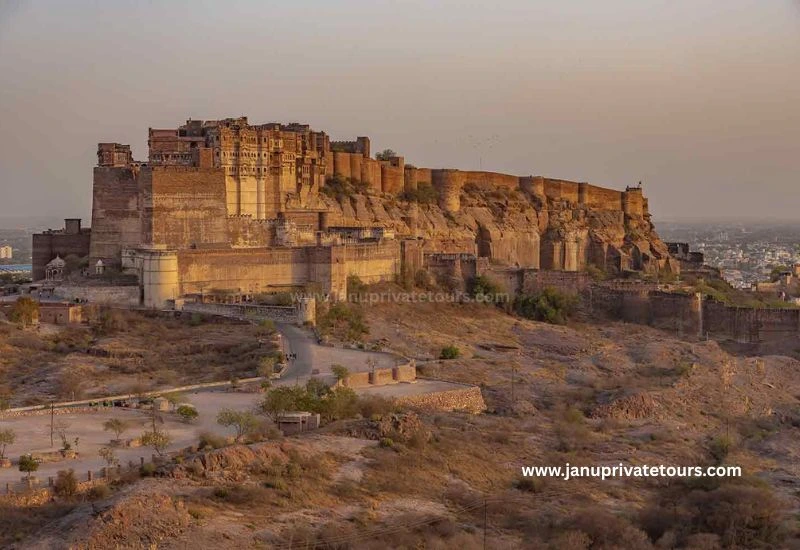
The second-largest city of Rajasthan, Jodhpur, is popularly known as the Blue City because of its blue-painted houses that surround its mighty fort. Founded in 1459 by Rao Jodha, the city famously sits at the edge of the Thar Desert with a rich heritage that has transformed it into a grand adventure comprising majestic forts, elegant palaces, lively markets and culinary worth.
Whether you are a history buff, cultural nomad or foodie at heart, there’s a royal trace in every significant landmark of Jodhpur reminiscent of the glorious past of the Marwar kingdom. Boasting imposing hilltop forts, bustling bazaars, and a spicy street-food culture to boot, the state capital of Rajasthan offers a quintessential Rajasthani experience. Here, let us discuss about the attraction in Jodhpur that you cannot miss.
Here, let us find out about the famous attraction in Jodhpur that you cannot miss:
Standing proudly at an elevation of 400 feet above the city skyline, Mehrangarh Fort is undoubtedly the most famous tourist destination in Jodhpur. Constructed by Rao Jodha in 1459, the fort’s gigantic stone structure seems to grow organically out of the rocky hill, making it a sight to behold.
The entrance to the fort passes through massive gates, each bearing the scars of battles fought long ago. Once inside, a series of beautifully decorated palaces showcases intricate carvings, latticed windows, mirror work, and painted ceilings.
Some of the most interesting attractions inside the fort are:
Moti Mahal (Pearl Palace), famous for its colorful glass windows
Phool Mahal (Flower Palace), famous for its gold filigree work
Sheesh Mahal (Mirror Palace), decorated with intricate mirror work
A museum housing royal costumes, arms, and palanquins
The fort’s ramparts offer a spectacular view of the blue houses below. Mehrangarh Fort is more than just a tourist destination—it is the symbol of Jodhpur itself, which tells the story of the centuries of Marwar’s courage and majesty.
Just a short walk away from Mehrangarh Fort is Jaswant Thada, a peaceful marble cenotaph erected in 1899 in memory of Maharaja Jaswant Singh II. This monument is commonly referred to as the “Taj Mahal of Marwar” because of its beautiful marble lattice screens and peaceful surroundings.
The marble used in the construction of this monument is so highly polished that it glows when the sunlight passes through it. The peaceful gardens and lake surrounding the monument provide a serene escape from the hustle and bustle of the city.
Jaswant Thada is a must-visit destination for travellers who are looking for architectural beauty as well as a place to reflect.
Umaid Bhawan Palace symbolizes the latter part of the royal lineage of Jodhpur. This magnificent palace was completed in 1943, and it was constructed during a famine to give employment to thousands of people.
The palace is a magnificent amalgamation of Art Deco and Rajput architectural designs. It is also one of the largest private residences in the world and is still partially occupied by the royal family.
The palace is currently divided into three parts:
A luxury heritage hotel
A royal residence
A museum containing vintage clocks, photographs, and royal artifacts
The museum part gives a glimpse into the life of the royal family in the 20th century and the transformation of the city into modern India. Umaid Bhawan Palace is a monument to compassion, strength, and architectural genius, making it a must-visit destination in Jodhpur.
Before Jodhpur was established, Mandore was the capital of Marwar. Currently, Mandore Gardens is home to royal cenotaphs, temples, and memorials that are located in beautifully landscaped gardens.
The red sandstone cenotaphs of past rulers are designed in a manner that looks like temple architecture and are intricately carved. The Hall of Heroes and the Shrine of the Three Hundred Million Gods give the place a spiritual and mythological twist.
Mandore Gardens gives a historical perspective that goes beyond the forts and is a very enriching experience for visitors to Jodhpur who are interested in the early history of the Rajputs.
The Clock Tower and the adjacent Sardar Market, situated in the heart of the old city, are the embodiment of the local culture of Jodhpur. The market is full of life and energy, and it provides everything, from handicrafts and clothes to spices and antiques.
One can purchase:
Bandhani cloth
Mojari shoes
Silver jewelry
Rajasthani spices
This market is a true reflection of the local culture of Jodhpur, and it provides a glimpse into the life of the locals.
Covering an area of 70 hectares, Rao Jodha Desert Rock Park is a nature conservation site established near Mehrangarh Fort. The park features desert flora and provides a walking route through the rocky landscape.
This site is a welcome relief from the city’s architectural wonders and showcases the desert environment of Rajasthan. As a natural wonder, this park is an unappreciated gem for nature lovers visiting Jodhpur.
Jodhpur is more than just a fort city; it is an experience of a living culture that still flourishes.
The folk music and dance of Rajasthan are inextricably linked with the history of the state. Kalbeliya dance, Manganiyar songs, and puppet shows are common at cultural centers and heritage hotels. These performances give a glimpse into the storytelling culture of the desert.
Festivals in Jodhpur are celebrated with remarkable enthusiasm. The Marwar Festival, organized every year, features folk music and dance. Diwali and Holi festivals turn the city into a colorful extravaganza of lights and happiness.
A walk through the blue-painted streets of the old city is in itself a popular tourist experience in Jodhpur. The color blue was originally linked to Brahmin homes but has now become a symbol of the city’s identity. The blue-painted streets now provide a beautiful backdrop for photography.
Jodhpur’s local cuisine is a reflection of the desert climate and the royal influences that have shaped it. The local cuisine is very flavorful, rich, and made in such a way that it can last for a long time in the desert climate. During your visit here, you must try these local foods in Jodhpur, which are equally important as the attraction in Jodhpur:
This is a traditional Rajasthani dish consisting of baked wheat balls, lentils, and churma, a sweet dish. This is a very satisfying dish.
This is a red mutton curry made with Mathania chilies. This dish was a favorite of the Rajput warriors.
This is a popular street food consisting of large green chilies stuffed with spicy potato and deep-fried to perfection.
This is a thick yogurt drink topped with butter and dry fruits. This is a very cooling drink after a sightseeing tour of the attraction in Jodhpur.
This is a crispy pastry filled with spiced onion mixture. This is widely available in the Clock Tower area of Jodhpur.
Trying out the street food and local restaurants is a must in Jodhpur for a foodie.
The best time to visit Jodhpur is from October to March when the climate is pleasant. During the winter season, it is possible to explore the forts and bazaars without the scorching heat of the desert. The early morning and late afternoon hours are the best times to visit the forts.
Jodhpur is a destination that seamlessly weaves history, culture, and cuisine into one single experience. The forts in Jodhpur speak of the history of bravery and royalty, the markets speak of the day-to-day life of the people, and the cuisine speaks of the rich tradition of food in the city.
Each destination in Jodhpur has a different story to tell, whether it is the majestic Mehrangarh Fort, the peaceful Jaswant Thada, or the bustling Sardar Market.
For those travelers who are looking for a complete experience of Rajasthan, Jodhpur has something to offer. It is a place where the past is still alive, and every nook and corner is an invitation to explore.
Jodhpur truly captures the essence of Rajasthan, making it one of the most interesting destinations in India.
Jodhpur is a place that will leave you with memories that will last a lifetime. But if you want to understand the history and culture that has been imprinted on Jodhpur’s forts and streets, then a guide can make all the difference. This is where Janu Private Tours comes in and takes your experience to the next level. With customized tours, local guides, and comfortable transportation, Janu Private Tours will help you see Jodhpur beyond the surface. Are you ready to experience all the amazing sights that Jodhpur has to offer in comfort and style? Then let Janu Private Tours help you have a royal experience.
Hi, I am Janu (Shabbir Khan)
Book a Free Call
+91 99291 52946