

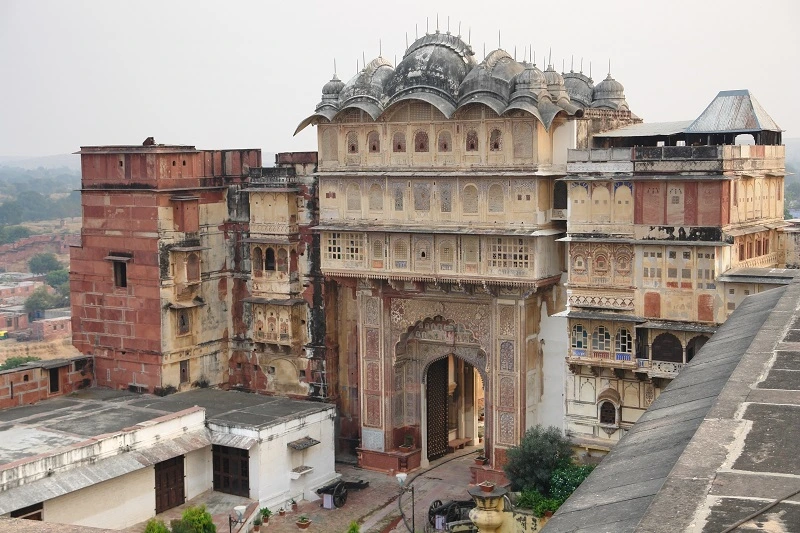
Rajasthan, a land steeped in rich history, is famous for its imposing forts, palaces, and monuments that reflect the grandeur of Indian royalty. These structures, built by various Rajput dynasties, Mughal emperors, and other rulers, stand as symbols of strength, beauty, and architectural ingenuity. Below is an overview of some of the most significant forts and palaces in Rajasthan: Combining both categories, the total comes to about 50 significant forts and palaces in Rajasthan. This number may include various smaller forts and palatial structures that contribute to the state’s rich historical marvels.
Exploring Rajasthan’s Monuments : A Journey Through Royal Heritage and Architectural Marvels
Forts
• Major Forts: About 30 notable forts, such as:
o Amber Fort (Jaipur)
o Mehrangarh Fort (Jodhpur)
o Jaisalmer Fort (Jaisalmer)
o Chittorgarh Fort (Chittorgarh)
o Junagarh Fort (Bikaner)
o Kumbhalgarh Fort
o Ranthambore Fort
o Taragarh Fort (Ajmer)
o Neemrana Fort
Palaces
• Major Palaces: Around 20 prominent palaces, including:
o City Palace (Jaipur)
o City Palace (Udaipur)
o Umaid Bhawan Palace (Jodhpur)
o Lalgarh Palace (Bikaner)
o Samode Palace
o Jai Mahal Palace (Jaipur)
o Fateh Prakash Palace (Udaipur)
Rajasthan is the birthplace of the distinctive Rajput culture, which has shaped its traditions and history. From the seventh to the nineteenth centuries, the region saw the rise and fall of the Rajputs—warriors tracing their lineage back to the sun and moon, denoted by the term Rajput, meaning sons of kings. Prominent clans include the Rathors of Jodhpur and Bikaner, the Gahlots and Sisodias of Udaipur, and the Kachhawahas of Jaipur, all claiming descent from revered figures like Lord Rama. The Bhattis of Jaisalmer assert a lunar lineage, while other clans, such as the Chauhans and Solankis, have legendary origins tied to sacred fire pits on Mount Abu.
Among the many states of historical Rajasthan, three principal kingdoms stand out:
• Mewar (centered around Chittorgarh and Udaipur),
• Amber (Jaipur)
• Marwar (encompassing Jodhpur, Jaisalmer, and Bikaner).
These Rajput strongholds faced numerous invasions by Muslim armies throughout history.
Notable attackers included Mahmud Ghazni in the eleventh century and Mohammad Ghori in the twelfth century, along with Qutub-ud-Din Aibak and Alauddin Khalji in the fourteenth century, who besieged key forts such as Ajmer, Ranthambor, and Chittor. The sixteenth century brought the significant Battle of Khanwa, where Mughal Emperor Babur defeated the Rajput chief Rana Sanga, leading to Mughal dominance over the region.
Amber Fort (or Amer Fort) is one of the most iconic and awe-inspiring forts in Rajasthan, India. Located just 11 kilometers outside Jaipur, the capital city of Rajasthan, Amber Fort stands on a hilltop, overlooking the Maota Lake. With its grand architecture, breathtaking surroundings, and fascinating history, Amber Fort continues to be a major attraction for tourists from around the world. Its blend of Hindu and Mughal architectural styles, combined with its imposing structure and serene beauty,
Amber Fort was originally built in the 16th century by Maharaja Man Singh I, a trusted general in Emperor Akbar’s army, who played a key role in the expansion of the Mughal Empire. While the fort’s foundation was laid by Maharaja Alan Singh in the 11th century, it was under Man Singh I that Amber Fort took its present form.
The fort was the seat of the Kachwaha Rajput dynasty before the capital of the kingdom was shifted to Jaipur in the 18th century. Over the centuries, the fort was expanded and renovated by subsequent rulers, including Maharaja Jai Singh I (founder of Jaipur), who added new features such as the Sukh Mahal and Shila Mata Temple.
Amber Fort is known for its unique blend of Rajput and Mughal architectural styles, which can be seen in the fort’s grandeur, intricate carvings, and elaborate decorative elements. Here are some of the key architectural features of Amber Fort:
• Sheesh Mahal (Mirror Palace) – One of the most remarkable features of Amber Fort, the Sheesh Mahal is an exquisite palace covered in thousands of tiny mirrors, creating an effect that is particularly striking when lit by candlelight. The walls and ceilings are intricately designed with mirrors and glasswork, which once reflected the light of a single lamp to illuminate the entire room.
• Diwan-i-Aam (Hall of Public Audience) – This large hall is where the ruler would meet with his subjects, hear their grievances, and conduct state business. The hall is known for its intricate carvings, columns, and arches, showcasing the blend of Rajput and Mughal design elements.
• Diwan-i-Khas (Hall of Private Audience) – The Diwan-i-Khas is another significant part of the fort, which was used for private meetings with high-ranking officials. The hall is famous for its marble inlay work and the central throne, which is surrounded by beautiful courtyards and gardens.
Ramparts, Kumbhalgarh Fort, Kumbhalgarh, Rajasthan : The outer wall of the Kumbhalgarh Fort embraces an area of several square miles. This wall is comparable to the grandeur of the Great Wall of China.
Victory Tower or Jaya Stambh is a masterpiece of fifteenth century revivalist Jain architecture, built by Rana Kumbha, one of the most powerful Kings of Mewar. It was designed by an architect called Jaita to commemorate the victory over Mahmud Khalji of Malwa in 1440 A.D. The tower was mainly built by compact limestone and the quartz rock on which it stands. It has nine storeys rising to 37.2 m above the ground level. In each tier of this tower, there is a mandapa associated with a temple, enriched with balconied windows and is carved profusely with the gods of the Hindu pantheon. The ninth storey has a vault with a sculptured representation of Lord Krishna surrounded by dancing gopis.
Bundi is situated in south-east Rajasthan. Bundi Fort was constructed by Rao Deva Hara in 1342 A.D. This fort is popularly known as Taragarh Fort. It is square in plan with large corner bastions. In the middle of the west wall there is a fine gateway and in the middle of the east wall, a postern. The ramparts are crenellated, with high parapets. The main gate, to the west is flanked by octagonal towers protected by a strong barbican. The main entrance has vaulted guard rooms, the fort is dominated by a huge masonry tower, the Bhim Burj, which was used to house one of the most famous cannons of this region, the sixteenth century Garbh-Ganjam (now lost). The Rani Mahal at Taragarh, stands reflected in a large tank, with delicate fading miniatures on walls and coloured glasses in windows. Bundi Fort contains many water tanks, one among them is the Sabirna-Dha-Ka-Kund. It is a deep, square stepped water tank, built in 1654 A.D. It is a fine example of three dimensional geometrical architecture.
Anup Mahal was built between 1669 and 1698 A.D. and was decorated later by Maharaja Gaj Singh. It is an exquisite building with a stunning coronation hall in red and gold. The Raj Tilak Hall, as it is known, is enriched with ornamental lacquer work and opaque glass inlay work. One anti-chamber is vivid aquamarine blue inlaid with gilt. Another room contains the famous hindola or swing, a rare specimen. The Anup Mahal is the epitome of the splendourand decorative art of Rajput architecture and is the fabulous treasure-house of a desert prince.
Located in the Jhalawar district of Rajasthan, Gagron Fort is a unique and lesser-known gem among the many forts of the state. This UNESCO World Heritage Site is distinct for its strategic position, built on a hilltop surrounded by rivers, and it represents an exceptional example of the fusion of hill, water, and land fortifications. The fort has a fascinating history, having been a stronghold for various Rajput rulers.
The fort was originally constructed in the 12th century by the Chauhan dynasty, with significant additions made by the Paramara rulers in the 14th century.
Strategic Importance: Gagron Fort was strategically positioned, making it an excellent defense post. Its location at the confluence of the Ahu and Kali Sindh rivers provided natural defenses, making it virtually impregnable.
Significance: The fort has a history of being involved in several battles and power struggles. It was part of the kingdom of Mewar at one point, and later, it came under the rule of Maharaja of Jhalawar.
Final Thoughts : The Timeless Legacy of Rajasthan’s Forts and Palaces
The forts and palaces of Rajasthan are more than just architectural masterpieces; they are living testimonies to the grandeur, valor, and cultural heritage of the region. From the towering walls of Mehrangarh Fort in Jodhpur to the shimmering beauty of the Lake Palace in Udaipur, each monument tells a unique story of royalty, warfare, sacrifice, and artistic brilliance.
These structures, whether perched on hilltops or nestled by serene lakes, embody the intricate craftsmanship of their creators and reflect the opulence of Rajasthan’s royal dynasties. With their impressive fortifications, ornate palaces, and intricate carvings, Rajasthan’s forts and palaces offer a glimpse into a glorious past marked by centuries of splendor and power.
As one embarks on a journey through these historic landmarks, from Amber Fort in Jaipur to Jaisalmer Fort, it becomes clear that Rajasthan’s architectural heritage is a living, breathing legacy—a legacy that continues to captivate travelers from all corners of the world. Whether you are an admirer of history, architecture, or culture, Rajasthan’s forts and palaces offer an unforgettable experience, preserving the tales of Rajput valor, royal opulence, and a bygone era of kings and queens.
In exploring these monuments, you not only travel through time but also witness the enduring spirit of Rajasthan—a state where history, art, and heritage come together to create a timeless mosaic of royal legacy.
for more information please connect with us @ +91 99291 52946 / +91 97846 11046
Hi, I am Janu (Shabbir Khan)
Book a Free Call
+91 99291 52946